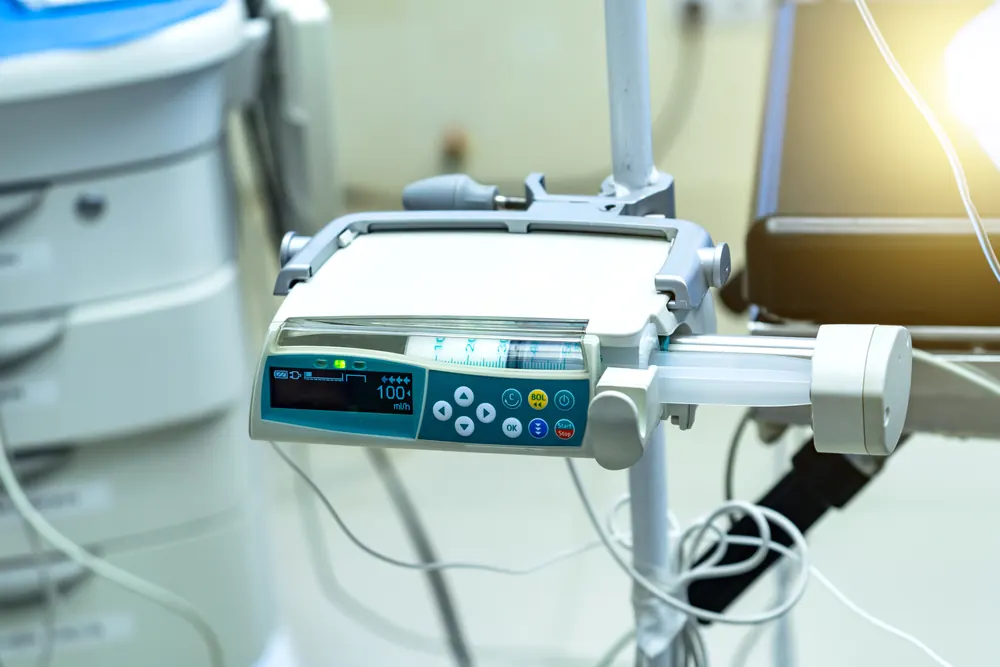
Healthcare
Compounds for device housings and mechanisms
POM, PC and PC/ABS compounds for the housings, clips, gears and sliding parts of healthcare equipment, with colour matching and lot traceability.
Healthcare equipment needs housings that stay tough and look right, and mechanisms that move precisely. We supply polyacetal for gears, latches and sliding parts, and polycarbonate and PC alloys for housings and covers. Grades can be tuned for flow, impact strength and colour.
Our scope is device housings and mechanical components. What we provide is consistency: ERP-controlled recipes, batch genealogy traced to the shipment, testing at three stages and RoHS and REACH compliance.
What the parts need
-
Precise mechanisms
Low-friction POM keeps gears, latches and sliding parts moving smoothly and quietly.
-
Tough housings
PC and PC/ABS give impact strength to housings and covers, including thin walls.
-
Low moisture uptake
POM absorbs little moisture, so small parts keep their dimensions in humid rooms.
-
Colour and finish
Spectrophotometer colour matching for visible housings, buttons and covers.
Typical parts
- Device housings
- Equipment covers
- Small gears
- Latches and clips
- Sliding mechanisms
- Buttons and knobs
- Hinges
- Castors and wheels



Questions buyers ask
How do you keep lots consistent?
Recipes, process windows and batch genealogy are controlled in our ERP. Every lot is tested on arrival of raw material, in process and before dispatch, and the records follow the shipment.
Which material suits small mechanisms?
OSATAL polyacetal is low in friction, resists wear and chemicals and absorbs little moisture, which suits gears, clips, latches and sliding parts. Glass-filled versions with 20% to 30% glass fibre add stiffness.
Can you match a housing colour?
Yes. We offer custom colour matching, measured by spectrophotometer against your master, for PC, PC/ABS and other housing grades.
Related industries
- AutomotiveUnder-hood, interior, exterior and EV parts
- Electrical & electronicsHousings, connectors, switchgear and lighting parts
- Home appliancesWhite-goods parts with stiffness, heat resistance and finish
- Consumer goodsFurniture, sports and household products in matched colours
- Industrial & textile machineryGears, bushes, rollers and wear parts for machinery
- Agriculture & irrigationUV-stable parts for tractors, sprayers and irrigation
- DefenceHigh-strength polyamide parts for demanding equipment

Send us your part
Share the drawing, the current material and the target properties. A materials engineer reviews every request, and a trial formulation follows in 48-72 hours.