The Compound · Materials
Recycled PP Compounds for Car Parts: Talc, Glass and Odour
Ask a vehicle programme where recycled content should go first and the answer is nearly always polypropylene. It is the workhorse of bumpers, wheel-arch liners, underbody shields, air ducts and interior carriers, and recycled PP streams already exist, from moulding scrap to crates and end-of-life bumpers. The engineering question is how to turn a variable recycled stream into a compound that behaves like the virgin grade on the drawing.
What recycling does to polypropylene
Every pass through an extruder shortens some PP chains, so melt flow tends to rise with each heat history. On top of that, recycled feedstock brings four problems that virgin resin does not.
| Issue | Effect on the part | Compounding answer |
|---|---|---|
| Melt flow drift (chain scission, mixed grades) | Fill, cycle time and weld lines change from lot to lot | Blend feedstocks to a melt flow window and test every batch |
| Polymer contamination, mainly PE in PP | Lower stiffness and heat resistance | Source segregation, FT-IR identification, rebalance of filler and modifier |
| Spent stabilisers | Early embrittlement in heat and sunlight | Restabilise with antioxidants and, for exterior parts, UV stabilisers |
| Residual volatiles | Odour and fogging | Devolatilisation in the extruder, odour absorbers where needed |
| Colour variation | Off-shade parts | Pre-colour to dark grey or black, delta E checked per batch |
PIR, the scrap from a known manufacturing process, carries far less of this than PCR, which has had a service life and shared a collection stream with other materials. That is the main reason PIR goes first on automotive parts. The definitions and the rules that count each are covered in PIR vs PCR plastics for automotive parts.
Talc-filled recycled PP
Talc is the default filler for automotive PP. Its plate-shaped particles raise flexural modulus and heat deflection temperature, cut moulding shrinkage and warpage, and keep large flat parts dimensionally steady. The cost is impact strength: more talc means a stiffer, more brittle compound, so talc-filled grades for bumpers and exterior parts carry an impact modifier as well.
In a recycled grade, the talc level and the modifier level are the levers that bring a variable base back onto target. Ash content confirms the filler level on every batch, and density cross-checks it. The reference point is the virgin grade the part was approved on, for example our OSALENE PPTF 20, a 20% talc, UV-stabilised PP. A recycled equivalent is engineered to the same property set rather than sold as a lookalike.
One thing talc does not do is fix odour. In the 2020 Waste Management study of post-consumer automotive PP, adding talc did not significantly improve the odour of the samples. Odour has to be controlled at the feedstock and in the extruder.
Glass-filled recycled PP
Where a part carries load, such as a bumper bracket, an engine cover or a structural carrier, glass fibre takes over from talc. Glass fibre only works in PP with a coupling agent, usually a maleic-anhydride-grafted PP, which bonds the fibre sizing to the non-polar matrix. Without it, the fibres pull out and the compound behaves like a filled grade, not a reinforced one. Published data for a chemically coupled virgin PP with 30% glass show a tensile modulus of 6,500 MPa and an HDT of 160 °C at 1.8 MPa, a useful benchmark for what a recycled glass grade should reach.
Two cautions apply to recycled glass grades. Feedstock that already contains glass, such as reground glass-filled parts, brings shortened fibres, so strength depends on how much fresh glass is added. And heat stabilisation matters more, because the recycled base has already spent part of its antioxidant package. Our virgin references here are OSALENE 30 NST (30% glass, heat stabilised) and the glass-plus-mineral PP GM 35 BK for parts that need lower warpage.
Odour and emissions: VDA 270 and VDA 278
VDA 270 is a sensory test. Specimens are conditioned in closed one-litre glass vessels under a variant the specification names, for example 23 °C for 24 hours, 40 °C for 24 hours or 80 °C for 2 hours, and a panel rates the odour from 1 (not perceptible) to 6 (unbearable), in half steps. The result is the mean of the individual ratings. VDA 278 is instrumental: thermal desorption and GC-MS measure volatile (VOC) and condensable fogging (FOG) emissions.
For recycled PP, the odour sources are known: residues from the first life of the material, inks and labels, and additives that have degraded. The Waste Management study found benzene- and phenol-type odorants and judged its post-consumer samples unsuitable for interior parts on both VDA 270 and GMW 3205. The control points follow from that:
- Feedstock selection. A single-source PIR stream with no food or packaging history is the easiest start.
- Devolatilisation. Venting on the twin-screw line strips volatiles while the melt is hot and thin.
- Odour absorbers. Used where a part needs them, not as a substitute for the first two.
- A written limit. The VDA 270 variant and grade, and the VDA 278 VOC and FOG limits, agreed per part before the first trial.
Which parts to convert first
| Part | Why it suits recycled PP | Typical starting point |
|---|---|---|
| Wheel-arch liners, splash guards | Non-visible, outside the cabin, impact matters more than surface | Impact-modified or talc-filled rPP, PIR then PCR |
| Underbody shields | Large, flat, non-visible | Talc- or glass-filled rPP |
| Air ducts | Non-visible; cabin air ducts need an odour check | Talc-filled rPP, odour-controlled |
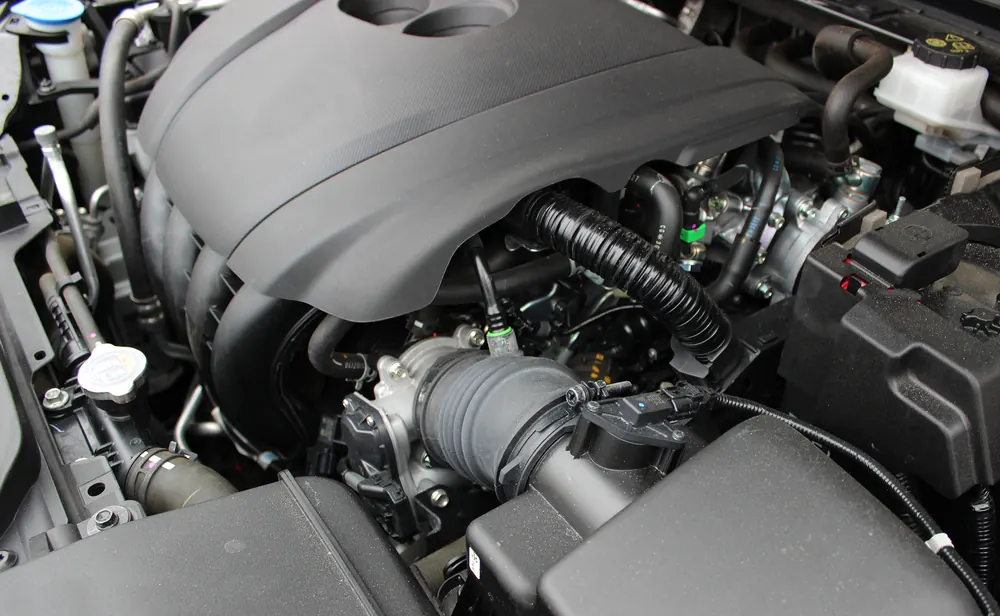
| Engine covers | Heat and moderate appearance | Heat-stabilised talc- or glass-filled rPP |
| Bumper brackets | Stiffness and creep under constant load | Glass-filled rPP |
| Returnable crates and dunnage | Off-vehicle, high volume, PCR-friendly | rPP from PCR |
Visible interior parts come last. They need colour, gloss and scratch performance on top of odour, and they are where a programme has the least tolerance for a surprise.
What to put in the brief
- The part, its current material and grade, and the drawing callout.
- The driver: EU closed-loop PCR, an OEM target, or cost and carbon. It decides PIR or PCR.
- The recycled-content target and how it must be declared.
- Property targets with test standards: MFI window, density, tensile and flexural modulus, Charpy or Izod, HDT.
- Odour and emissions: VDA 270 variant and limit, VDA 278 limits, if the part shares the cabin air.
- Colour, annual volume and the approval path (PPAP, on-vehicle trial).
How we build recycled PP grades
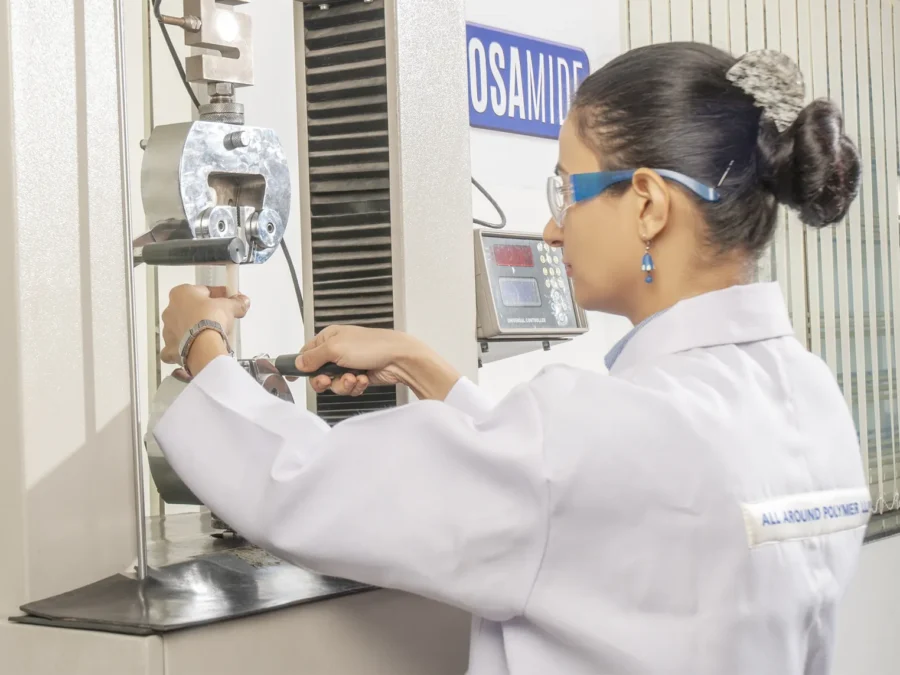
Our PIR and PCR grades run through four checks: incoming feedstock (segregation, contamination screen, FT-IR), twin-screw compounding with devolatilisation and recipe-locked dosing, batch QC (MFI, density, ash, tensile, flexural, Izod, HDT and delta E on every batch), and your approval path. The lab, ERP batch genealogy and certificate of analysis are the same ones that cover our virgin grades; see our quality page.
FAQ
Can recycled PP match a virgin talc-filled PP?
On the properties a part is approved on, yes, if the grade is compounded to that property set and held to a batch window. Agree the tolerances in the material specification, since some may be wider than for virgin resin.
How much recycled content can a talc-filled PP grade carry?
It depends on the feedstock and on how tight the property and odour targets are. Start from the target, let the trial set the ceiling, and expect non-visible exterior parts to accept the highest shares.
Does adding talc reduce the odour of recycled PP?
Not on its own. In the 2020 Waste Management study, talc did not significantly improve the odour of post-consumer automotive PP. Feedstock choice and devolatilisation do most of the work.
Is recycled PP suitable for battery trays and structural parts?
Glass-filled recycled PP can suit load-bearing parts outside the cabin, but treat them like any structural change: creep, heat ageing and impact data at service temperature, then a part trial.
Want to move a PP part to recycled content? Send the part, the current grade and the property and odour targets through our contact page, and we will propose a PIR or PCR route with a trial formulation.
Sources
- FILK Freiberg Institute: VDA 270 odour test, variants and grading scale
- Markes International: VOC and FOG emissions from automotive interior materials to VDA 278
- Prado et al., Odor characterization of post-consumer and recycled automotive polypropylene, Waste Management 115 (2020)
- LyondellBasell: Hostacom FPP 30GFC NAT, 30% glass, chemically coupled PP homopolymer
- European Parliament: Circular economy, deal on new EU rules for the automotive sector