Recycled compounds: PIR and PCR
Recycled plastic compounds, engineered to spec
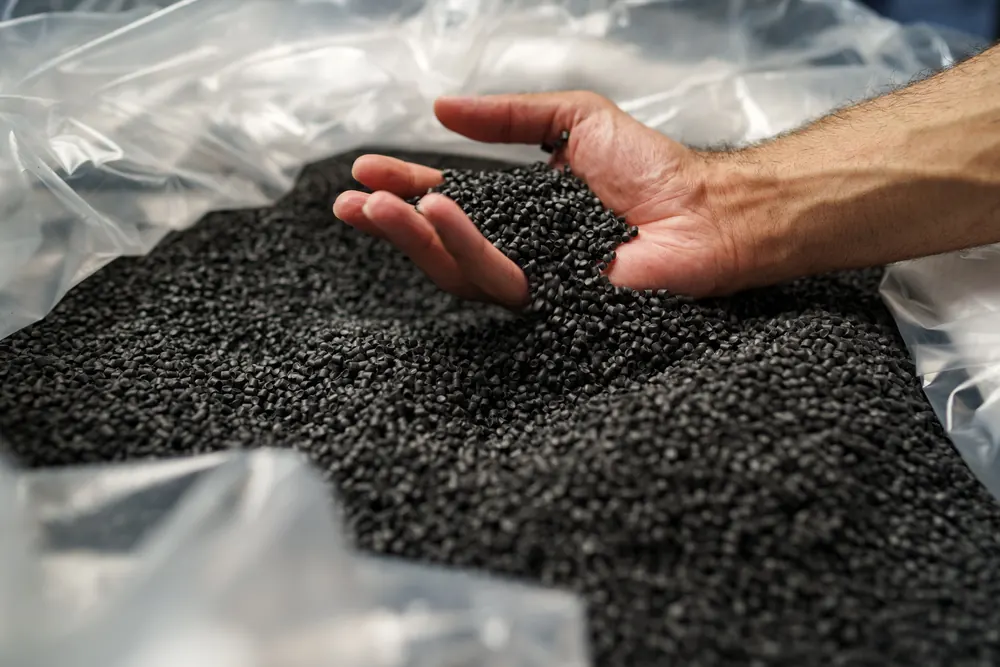
We compound post-industrial (PIR) and post-consumer (PCR) recycled polymers into PP, TPO, nylon, ABS and PC blend grades at our two plants in India. Each grade is built to a target property set and tested batch by batch, like our virgin grades.
Recycled content is one input, not the product
A recycled compound is still a formulation. We start from a base polymer, which can be virgin, PIR or PCR, and add the package the part needs: talc, mica or glass fibre for stiffness, impact modifiers, UV stabilisers, flame retardants, odour absorbers, antistat and pre-colour.
The target is the part, not the feedstock. We set the property window first (stiffness, impact, low shrinkage, paintability, scratch and mar, gloss, heat resistance, VDA 270 odour and VDA 278 emissions) and engineer the recycled grade to meet it. We do not sell recycled material as-is.
The same laboratory, ERP recipe control and batch QC run our recycled and virgin grades, so a recycled grade arrives with the same test data and documentation as a virgin one.
- Base polymers: PP homopolymer and copolymer, TPO, PA6, PA66, ABS, PC blends, POM
- Feedstock: virgin, PIR or PCR, matched to the part and to the compliance driver
- Recipes locked in ERP, with batch genealogy from raw material to shipment
- Certificate of analysis (CoA) with every lot
PIR or PCR: which feedstock for which job
Both terms follow the definitions in ISO 14021. The difference is where the material was recovered, and that decides how much control it needs.
PIR: post-industrial recycled
- Diverted from a manufacturing waste stream before it reaches a consumer
- Cleaner, consistent and single-source
- The natural first step for automotive parts
- Our route for recycled PP, TPO, PA6, PA66, ABS and PC-ABS grades
PCR: post-consumer recycled
- Recovered from end-of-life products
- A higher sustainability credential
- Needs stronger contamination and odour control
- Favoured by EU closed-loop targets
Why recycled content is on your RFQ now
Regulation is turning sustainable automotive plastics from a preference into a requirement. These are the public rules our customers cite most often.
| Market | Rule | What it means for plastic parts |
|---|---|---|
| India | End-of-Life Vehicle Rules 2025 | Extended producer responsibility for vehicle makers from 1 April 2025 |
| India | Plastic Waste Management (Amendment) Rules | Rising recycled-content shares for rigid plastic packaging |
| European Union | End-of-Life Vehicles Regulation (EU) 2026/1738 | In force since 13 August 2026: 15% recycled plastic in newly type-approved vehicles from 2032 and 25% from 2036, at least a fifth of it from end-of-life vehicles |
| Japan | Plastic Resource Circulation Act (2022) | Pushes design for recycling and the use of recycled content |
Summaries for context only, not legal advice. Check the current text of the rule your programme answers to.
How we control quality in a recycled grade
Recycled feedstock varies more than virgin resin. Four checkpoints absorb that variation before the pellets reach your moulding shop.
- 01
Incoming feedstock
Each source is kept segregated, screened for contamination and identified by FT-IR before it is dosed.
- 02
Extrusion
Twin-screw compounding with devolatilisation and recipe-locked dosing. Odour is controlled in the process.
- 03
QC and colour
MFI, density, ash, tensile, flexural, Izod, HDT and delta E on every batch, checked against the grade's property window.
- 04
Approval path
PPAP, material-spec conformance and on-vehicle trials, run with your engineering team before series supply.
Where recycled grades fit first
Start with non-visible parts and scale as data builds. These are the typical routes.
-
Underbody and exterior
Talc- or glass-filled rPP for wheel-arch liners, splash guards, underbody shields and bumper brackets. PIR first, PCR later.
-
Under the hood
rPP for air ducts and engine covers. rPA6 and rPA66 from PIR, on an OSAMIDE base, for brackets, structural clips, fan and shroud parts.
-
Bumpers and cladding
TPO blends from PIR or PCR for bumper substrates and exterior cladding.
-
Interior substructure
rABS and rPC-ABS from PIR for interior trim carriers, non-visible brackets and console substructure.
-
Crates and dunnage
PCR grades for returnable crates and dunnage, where the recycled credential counts most.
-
Next phase
rHDPE from PCR for non-critical reservoirs and trims, as programmes ask for it.
- 1,975 kg/hrnameplate compounding capacity
- 4 linestwin-screw lines, from 75 kg/hr trials to 1,250 kg/hr volume
- 48-72 hto a trial formulation
- 150+grades developed in four years
Choose your route
- PIR compoundsPost-industrial recycled PP, TPO, PA6, PA66 and ABS for automotive and industrial parts, with the PPAP path.
- PCR compoundsPost-consumer recycled grades for crates, dunnage and non-visible parts, with contamination and odour control.
- Quality and testingOur laboratory, batch testing and a CoA with every lot.
- Material finderFilter our published grades by polymer, filler and property.
Recycled compounds: common questions
Do recycled compounds perform like virgin grades?
A recycled grade is engineered to the property set the part requires and tested on every batch. Where recycled content shifts a property, we compensate with the additive package or adjust the recycled share.
What is the difference between PIR and PCR?
PIR is diverted from a manufacturing waste stream before it reaches a consumer. PCR is recovered from end-of-life products. Both definitions follow ISO 14021.
How much recycled content can a grade carry?
It depends on the part, the property window and the feedstock. Tell us your target recycled share and required properties, and we will propose a trial formulation in 48-72 hours.
How do you control odour?
At the source: feedstock selection, devolatilisation during twin-screw compounding and odour-absorber additives where the part needs them. VDA 270 limits are agreed per part.
How much CO2e does recycled PP save?
Published life-cycle reviews put recycled PP at roughly 55 to 70% lower cradle-to-gate CO2e than virgin PP. That is an industry estimate, not an AAP guarantee. A figure for your part has to be recalculated with your part data under ISO 14067.
Can you support recycled-content certification?
We support your recycled-content documentation and can work to the certification scheme your programme requires. Tell us the scheme at the RFQ stage.
Where are your recycled grades made?
At our two plants in MET City, Jhajjar, Haryana, in the Delhi NCR, with the same laboratory, ERP control and batch QC as our virgin grades.
Send us the part and the recycled target
Share the drawing, the property window and the recycled share you need, and we will propose a trial formulation in 48-72 hours.