The Compound · Sourcing
Custom Polymer Compounding: From Brief to Approved Grade
Catalogue grades cover most parts. Custom polymer compounding earns its place when they do not: a property combination nobody lists, a cost target, a substitute for an imported grade, or a colour that has to match a mating part. We have developed more than 150 new grades this way in four years, and 70 to 80% of our development projects convert to supply.
This note sets out how a development runs at AAP, from the first email to the first production delivery, and what a buyer or design engineer can do to shorten it.
The brief to send
Development time is mostly decided before any material is weighed. A vague request costs a round of questions; a wrong assumption costs a round of trials.
| Send us | Example | Why it matters |
|---|---|---|
| The part and its job | Drawing or photos, thinnest wall, what it mates with | Sets flow, stiffness and rating thickness |
| Current material | Grade name and TDS, or a moulded part | Gives a baseline to match or beat |
| Must-have properties | Tensile, impact, HDT, each with its test standard | ISO and ASTM values are not interchangeable |
| Operating environment | Temperature, chemicals, UV, humidity | Decides the stabiliser package |
| Regulatory needs | UL 94 rating and thickness, glow-wire, RoHS, REACH, halogen-free | Some tests need external labs and add time |
| Colour | Physical reference, tolerance, light sources | Colour work can run alongside property work |
| Processing | Machine, hot or cold runner, cycle time, drying set-up | Avoids a grade that only works on paper |
| Commercials | Annual volume, target price, delivery location | Shapes the formulation route from day one |
If you need flame-retardant performance, our note on UL 94, glow-wire and CTI lists what to specify. For importers weighing an Indian source, sourcing engineering plastics from India covers the commercial side.
Concept to Creation: the eight steps
Our development process has eight steps:
- Customer enquiry
- Team discussion
- R&D formulation
- Product sample
- Technical evaluation
- Customer delivery for trial
- Final approval
- Delivery
Running across those steps are five stage gates. Each gate is a decision point, and each has a clear owner.
| Stage gate | Steps | What happens | Who owns it |
|---|---|---|---|
| Customer request | 1–2 | Brief discussed by our team; gaps and open questions sent back | Shared |
| Trial formulation | 3 | Formulation designed and compounded | AAP |
| Lab batch on R&D line | 4–5 | Batch run on the R&D line, specimens moulded and tested | AAP |
| Industrial trial | 6 | Material made for your moulding trial | AAP makes, you mould |
| Customer approval | 7–8 | Your part tests and sign-off, then supply | You, then AAP |
48 to 72 hours: what it covers
The 48 to 72 hour figure runs from a clear request to a trial formulation. It is not the time to an approved grade, and it is not a promise of a certified test result. It means the first real material exists within days, so the conversation moves from datasheets to parts quickly. For regular customers, product testing during development is free.
The lab batch on the R&D line
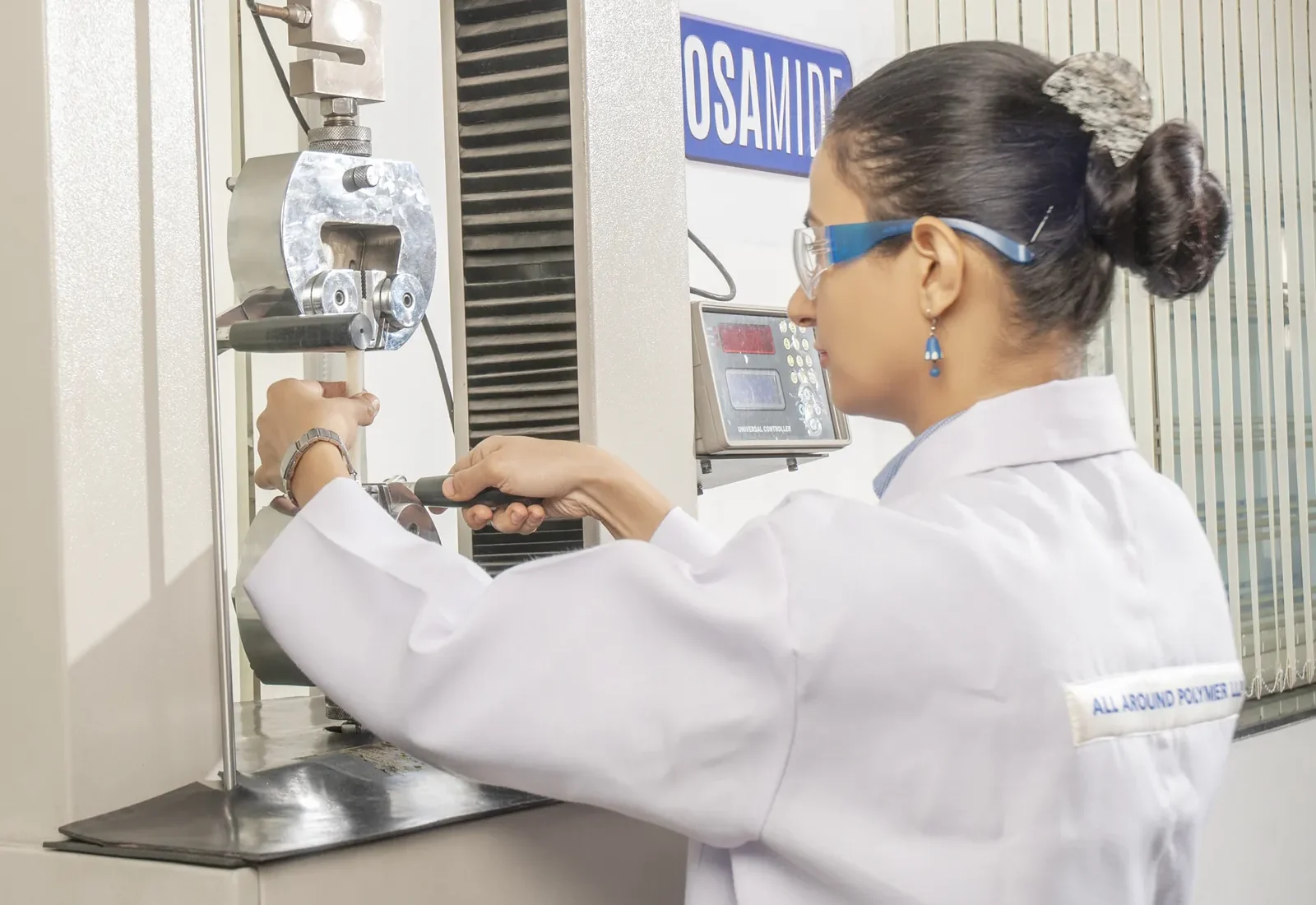
Trial formulations run on our 75 kg/hr line, which is kept for R&D and small-batch work. That keeps development off the production schedule and lets us run several variants in a short time. Our lab then moulds test specimens and checks the properties that matter for your brief: MFI, tensile and flexural strength on a UTM, Izod impact, HDT and Vicat, DSC, FT-IR, colour by spectrophotometer, and glow-wire for FR grades. External lab testing is available on request.
The industrial trial
Once a lab batch meets the targets, the grade is run on a production line and material goes to you for a moulding trial. The process window recorded here becomes the controlled recipe version in our ERP, along with the bill of materials, so later batches follow the approved route. Our note on the compounding line shows what that involves.
Customer approval
This is usually the longest gate, and most of it sits on your side: moulding trials, part testing, sometimes your own customer's sign-off. Booking a moulding slot and a test plan early is the easiest way to save weeks.
Colour matching
Send a physical reference rather than a code alone, ideally on the same surface texture as the final part. Gloss and grain change how a colour reads. State your tolerance as a ΔE value, with the formula you use (CIEDE2000 is common) and the light sources you check under. A match that holds in daylight can drift under shop lighting; that effect is called metamerism.
As a rough guide, a ΔE below 1 is generally imperceptible, 1 to 2 barely noticeable, and 3 or more clearly visible. Real tolerances depend on the application, and you set them. Two practical limits are worth knowing: glass fibre and some FR systems restrict the shades that can be reached, so tell us about both before colour work starts.
What speeds it up, and what slows it down
Faster:
- A complete brief with test standards attached.
- A moulded part or pellets of the current material for benchmarking.
- One technical contact who can answer questions within a day.
- Agreement on test methods before the first lab batch.
- A moulding trial slot booked while the lab batch is running.
Slower:
- Targets that change between trials.
- Mixing ISO and ASTM data without saying so.
- Trials on worn tools, or with material that has not been dried. Wet polyamide can fail a trial that dry material would pass; see drying nylon.
Browse our families in the material finder, or see the capabilities behind development work.
FAQ
Does a 48 to 72 hour trial formulation mean approval in three days?
No. It means a first trial formulation within that window after a clear request. Lab testing, your moulding trial and your sign-off follow, and their length depends mostly on the part and your validation plan.
Can you match an imported grade we use today?
Send its TDS and, ideally, pellets or moulded parts. We formulate against the properties that matter, measured by the methods you specify. Whether it is a true drop-in is decided by your moulding trial, not by a datasheet comparison.
Who pays for testing during development?
Product testing is free for regular customers. Certified tests run by external laboratories, such as UL 94 classification, are arranged on request; raise them at the brief stage so their timing is planned in.
Have a part that needs a grade nobody stocks? Send us your brief, or request a TDS or sample, and we will come back with questions or a trial plan.