The Compound · Sourcing
PIR vs PCR Plastics for Automotive Parts: Where Each Fits
A purchasing brief that says “30% recycled content” leaves the key question open: recycled from what? A runner stream from one moulding plant and a bale of mixed household packaging can both be sold as recycled polypropylene. They behave very differently in an extruder, in a mould and in a car.
What PIR and PCR mean under ISO 14021
The terms come from ISO 14021, the international standard for self-declared environmental claims such as “contains 30% recycled content”. It defines recycled content as the proportion, by mass, of recycled material in a product, and only two kinds of material count.
- Pre-consumer material, usually called PIR or post-industrial recycled in the plastics trade: material diverted from the waste stream during a manufacturing process. The standard excludes rework, regrind or scrap that can be reclaimed within the same process that generated it. Regrind fed back into the press that made it is good housekeeping, not recycled content.
- Post-consumer material, or PCR: material generated by households, or by commercial, industrial and institutional facilities in their role as end users, which can no longer be used for its intended purpose. Returns from the distribution chain are included.
Many specifications still cite the 2016 edition. ISO published a third edition, ISO 14021:2026, in June 2026, so confirm which edition your customer’s programme references when you write the claim.
PIR and PCR side by side
| PIR (post-industrial) | PCR (post-consumer) | |
|---|---|---|
| Typical sources | Moulding and extrusion scrap, off-spec production, purged material from a known process | End-of-life vehicles, bumpers, crates, household and commercial packaging, appliance casings |
| Composition | One known grade or a few, often single-source | Mixed grades and polymers: PE in PP, fillers, paint, labels |
| Lot-to-lot consistency | High, if the source is stable | Lower; needs blending, screening and tighter QC |
| Odour and emissions | Close to the grade it came from | Higher risk from residues, inks and degraded additives |
| Regulatory weight | Valid ISO 14021 claim | Stronger credential; the only kind the EU vehicle rules count |
| Natural first parts | Non-visible brackets, carriers, under-hood clips | Wheel-arch liners, underbody shields, crates and dunnage |
Consistency: the first engineering question
Virgin resin arrives with a narrow melt flow window and a known additive package. Recycled feedstock arrives with a history: short and documented for PIR, years of service and a mixed collection stream for PCR.
The effect shows up in three numbers a buyer can track batch by batch: melt flow rate, density and ash. Melt flow drift changes fill and cycle time; density or ash drift signals a change in filler or contamination, which moves stiffness and shrinkage. Polyethylene in a polypropylene stream is the classic PCR case, lowering stiffness and heat resistance. The answer is not to avoid PCR. It is to segregate sources, identify polymers on the way in, and compound to a property target.
Odour: where PCR needs the most work
Interior parts are judged by smell as well as strength. Many OEM specifications use VDA 270, where a trained panel rates odour from a sealed test vessel on a scale from 1 (not perceptible) to 6, and VDA 278 or similar methods for emissions. A study of post-consumer and recycled automotive polypropylene, published in Waste Management in 2020, found the samples unsuitable for interior parts on both GMW 3205 and VDA 270. The authors traced part of the odour to degraded additives, and adding talc did not significantly improve it.
Odour control therefore starts at the feedstock: choose the source, devolatilise in the extruder, and add odour absorbers where the part needs them. Most programmes put PCR into exterior and underbody parts first. Agree the VDA 270 variant and limit for each part before the first trial.
What the regulations count
The choice between PIR and PCR is increasingly set by the rule a programme answers to.
- European Union. Regulation (EU) 2026/1738 on end-of-life vehicles entered into force on 13 August 2026. Plastic in newly type-approved vehicles must contain at least 15% recycled plastic by weight from 2032 and 25% from 2036. The recycled share must come from post-consumer plastic waste, and at least 20% of it must be closed loop: recycled from end-of-life vehicles or parts removed during use. PIR does not count. Published summaries also report that recycled plastic sourced outside the EU will not count before August 2030, and only under equivalence conditions after that.
- India. The Environment Protection (End-of-Life Vehicles) Rules, 2025, in force since 1 April 2025, put extended producer responsibility on vehicle makers, including scrapping targets. Over time they turn end-of-life vehicles into a domestic PCR feedstock.
- OEM targets. Many carmakers set their own recycled-content goals. Check whether yours accepts pre-consumer material and which standard the claim must follow.
Carbon: an estimate, not a guarantee
Recycled resin skips monomer production and polymerisation, so its footprint is usually lower. A 2023 analysis in PNAS put mechanically recycled rigid polypropylene at about 80% lower life-cycle greenhouse gas emissions than virgin material; other studies report smaller savings. Treat such figures as industry estimates. A number for your part should be calculated with your part data under ISO 14067.
Where each feedstock fits on a vehicle
| Parts | Base compound | Feedstock route |
|---|---|---|
| Wheel-arch liners, splash guards, underbody shields | rPP, talc or glass filled | PIR first, PCR next |
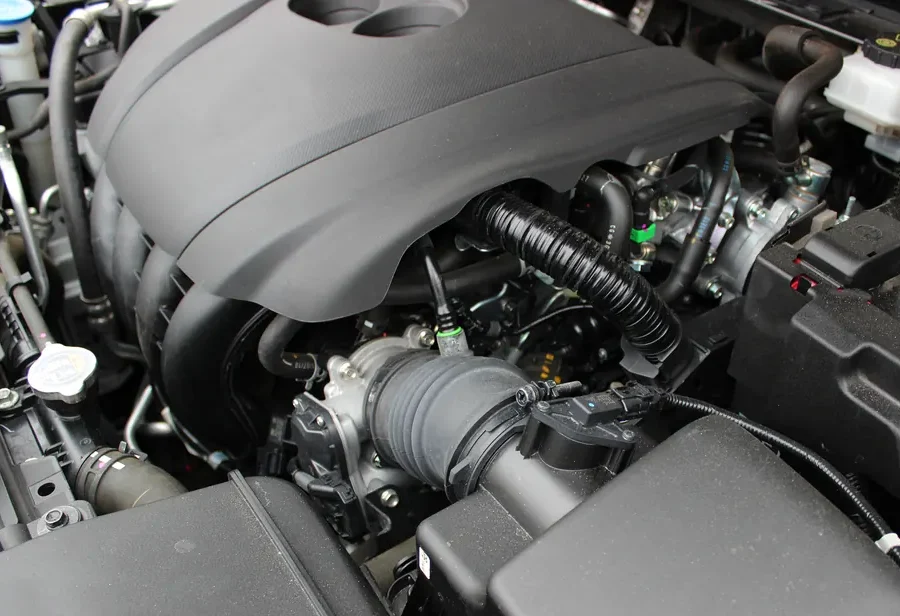
| Air ducts, engine covers, bumper brackets | rPP, talc or glass filled | PIR first, PCR next |
| Bumper substrates, exterior cladding | TPO blends | PIR or PCR |
| Interior trim carriers, non-visible brackets, console substructure | rABS, rPC/ABS | PIR |
| Under-hood brackets, structural clips, fan and shroud parts | rPA6, rPA66 | PIR |
| Returnable crates and dunnage | rPP | PCR |
| Non-critical reservoirs and trims | rHDPE | PCR, later phase |
How to start without risking the programme
- Pick a non-visible part with margin, such as an over-specified bracket or liner.
- Name the driver. EU closed loop, an OEM target, or a cost and carbon goal each point to a different feedstock.
- Write a target property set, not “recycled PP”: melt flow window, density, tensile and flexural modulus, Izod or Charpy, HDT, colour, and VDA 270 and VDA 278 limits if the part shares the cabin air.
- Agree the paperwork: the recycled-content declaration, the ISO 14021 edition, and any certification scheme your programme requires.
- Run your usual approval path: lab trial, material-spec conformance, PPAP, on-vehicle trials. Scale up as data builds.
How we control recycled grades
We supply both PIR compounds and PCR compounds, matching the feedstock to the part and the compliance driver. Recycled content is one input in a formula we already control: a base polymer from our OSALENE (PP), OSAMIDE (PA6, PA66), ABS or PC-blend ranges, plus fillers, modifiers, stabilisers, odour absorbers or pre-colour, engineered to a target property set.
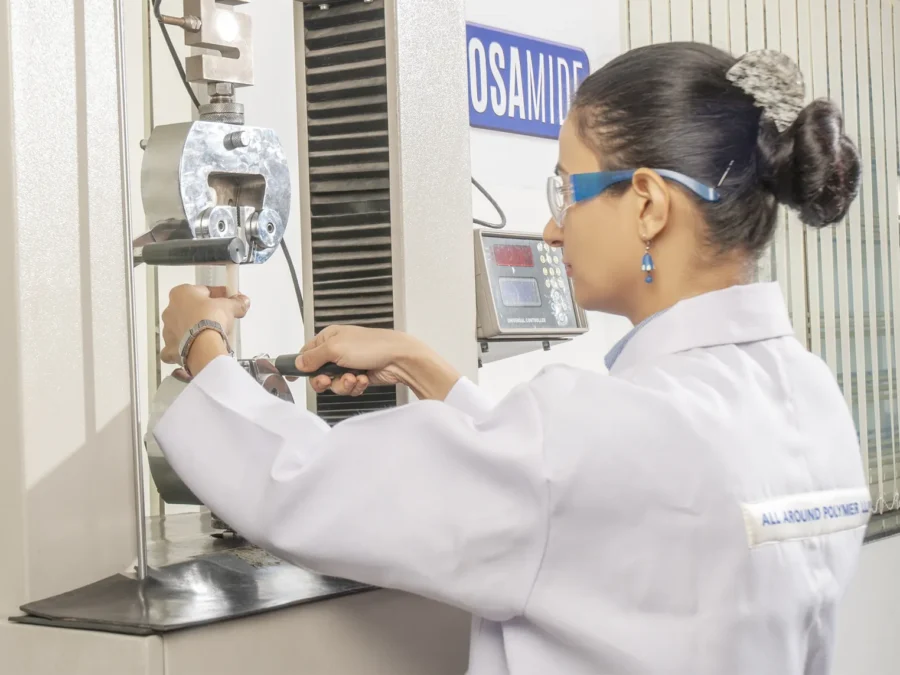
Each recycled grade passes four checks: incoming feedstock (source segregation, contamination screen, FT-IR polymer identification), twin-screw compounding with devolatilisation and recipe-locked dosing, batch QC (MFI, density, ash, tensile, flexural, Izod, HDT and delta E on every batch), and your approval path. The same lab, ERP and quality system controls our virgin grades. We support customers’ recycled-content documentation and can work to the certification scheme your programme requires. For the PP side in detail, see recycled PP compounds for car parts.
FAQ
Is regrind the same as PIR?
No. Under ISO 14021, scrap that can be reclaimed within the same process that generated it is excluded from recycled content. Sprues reground and fed back into the same press do not count. Scrap diverted from that process and compounded into a different product typically qualifies as pre-consumer.
Does PIR count toward EU recycled-content targets for vehicles?
Not under Regulation (EU) 2026/1738, which counts post-consumer plastic only, with a closed-loop share from vehicles. PIR is still a valid ISO 14021 claim, and it is a practical way to build test data on recycled grades before PCR.
Can PCR be used for interior parts?
It can, but odour is the gate. Start with exterior and underbody parts, agree VDA 270 and VDA 278 limits part by part, and move into the cabin once a grade has a record of passing them.
Planning recycled content for a vehicle programme? Send the part, the current material, the driver and your property targets through our contact page. We will propose a PIR or PCR route and a trial formulation, typically within 48-72 hours.
Sources
- ISO: ISO 14021:2016, self-declared environmental claims (revised by ISO 14021:2026)
- GreenSpec: Recycled content, ISO 14021 definitions of pre- and post-consumer material
- KRAIBURG TPE: Post-industrial material under DIN EN ISO 14021:2016
- European Parliament: Circular economy, deal on new EU rules for the automotive sector
- Rematec: Regulation (EU) 2026/1738 on end-of-life vehicles
- CDX: EU ELV Regulation officially published, what changed since Council adoption
- SCC Online: Environment Protection (End-of-Life Vehicles) Rules, 2025
- Prado et al., Odor characterization of post-consumer and recycled automotive polypropylene, Waste Management 115 (2020)
- Nordahl et al., Complementary roles for mechanical and solvent-based recycling in low-carbon, circular polypropylene, PNAS (2023)