The Compound · Materials
Flame Retardant Nylon UL94 V0: Ratings, Glow-Wire and CTI
Ask the market for flame retardant nylon UL94 V0 and you will be offered dozens of grades. Most meet that line on paper. Fewer survive the full specification: a glow-wire requirement, a tracking index for creepage, a colour, and a wall thinner than the test bar. Here are the tests in the order a design engineer usually meets them.
What UL 94 actually measures
UL 94 is a small-flame test on moulded bars and plaques. It classifies the material, not your finished part.
HB: horizontal burn
A bar is held horizontally and a 20 mm flame is applied for 30 seconds. The material passes HB if the burn rate stays at or below 75 mm/min for specimens under 3 mm thick, or 40 mm/min for 3 to 13 mm, or if the flame goes out before the first mark. HB is the entry level, common on housings with no ignition source inside.
V-2, V-1, V-0: vertical burn
The bar hangs vertically, a 20 mm flame is applied twice for 10 seconds, and cotton sits underneath to catch drips.
| Rating | Afterflame per application | Total afterflame, 5 bars | Flaming drips may ignite cotton |
|---|---|---|---|
| V-0 | 10 s or less | 50 s or less | No |
| V-1 | 30 s or less | 250 s or less | No |
| V-2 | 30 s or less | 250 s or less | Yes |
No bar may burn up to the holding clamp at any of the three levels.
The drip column matters more than it looks. In unfilled polyamide, some FR systems pass by dripping away the burning material. Add glass fibre and the fibres act as a wick that holds the melt in the flame, so a package that works in unfilled PA66 can fail in PA66 GF30. Glass-filled FR nylon usually needs a different chemistry, not just more of the same additive.
5VB and 5VA
These use a 125 mm flame applied five times to bars and a plaque. UL describes this ignition source as roughly five times more severe than the small-flame tests. Neither rating allows dripping. 5VB tolerates a hole burned through the plaque; 5VA does not. You meet 5VA on enclosures where a larger fire could start inside the product.
Read the thickness on every rating
Each rating is listed against a minimum thickness, and thin walls are harder to pass. If your thinnest rib is 0.6 mm, ask for the rating at or below 0.6 mm. Pigments can shift results too, so confirm the rating covers the colour you will buy.
Glow-wire: the appliance test
Where UL 94 uses an open flame, glow-wire simulates an overheated contact. A heated wire loop is pressed into the specimen with a force of 1 N for 30 seconds, with tissue paper underneath to show whether drips ignite.
There are three variants:
- GWEPT, IEC 60695-2-11. Run on the finished part, pass or fail at a set temperature such as 550, 650, 750, 850 or 960 °C.
- GWFI, IEC 60695-2-12. Run on material plaques. The highest temperature at which the specimen either does not ignite or self-extinguishes within 30 seconds of the wire being removed, without drips igniting the tissue.
- GWIT, IEC 60695-2-13. Also on plaques. It is 25 K above the highest temperature at which the material does not ignite (a flame lasting more than 5 seconds counts as ignition) in three successive tests.
Why appliance buyers ask for it
IEC 60335-1 sets severity by how the appliance is used. In unattended appliances such as washing machines, refrigerators and dishwashers, insulating parts supporting connections above 0.2 A face the toughest route: a material GWFI of at least 850 °C (or an end-product pass at 850 °C), then a GWIT of at least 775 °C (or an end-product pass at 750 °C with no flame lasting over 2 seconds). Otherwise, surrounding parts must be V-1 or better or pass a needle-flame test.
Material indices come from flat plaques. A part with thin walls, sharp edges or metal inserts can behave differently, so the end-product test has the last word.
CTI: the number that decides creepage
Comparative Tracking Index (IEC 60112) is the voltage at which a material withstands 50 drops of 0.1% ammonium chloride solution without forming a conductive track. The method tops out at 600 V. UL 746A groups results into performance level categories:
| CTI (V) | PLC |
|---|---|
| 600 and above | 0 |
| 400 to 599 | 1 |
| 250 to 399 | 2 |
| 175 to 249 | 3 |
A higher CTI allows shorter creepage distances at the same working voltage, so tracking resistance climbs the spec as connectors shrink. Brominated systems with antimony synergists tend to pull CTI down, one reason halogen-free packages are common in connectors. For the high-voltage side, see plastics in electric vehicles.
Halogen-free FR: what changes
The broad choice is between brominated systems and halogen-free routes: phosphorus-based (metal phosphinates, red phosphorus), nitrogen-based (melamine cyanurate, melamine polyphosphate) and inorganic hydroxides.
RoHS restricts specific substances, including PBB and PBDE; it does not ban brominated flame retardants as a class. "Halogen-free" is usually an OEM requirement on top of RoHS, so it must be written into the specification rather than assumed.
Halogen-free packages have trade-offs: loadings that can cost impact strength, tighter melt-temperature control, and, with red phosphorus, a limited colour palette. That is why an FR brief should state which properties can move and which cannot.
FR across the AAP families
FR is available on request across all our families. Typical starting points:
| Family | Base polymer | Typical FR uses |
|---|---|---|
| OSAMIDE | PA6, PA66, PA6T/6I | Connectors, terminal blocks, switchgear and breaker parts, coil formers |
| OSABATE | PBT | Connectors, relay bases, lamp holders |
| OSANATE | PC | Covers, enclosures, diffusers |
| OSAALLOY | PC/ABS and other blends | Charger, adaptor and meter housings |
| OSALAC | ABS | Housings; OSALAC 3000 is an unfilled FR, UV-stabilised ABS |
| OSALENE | PP | Appliance internals on request |
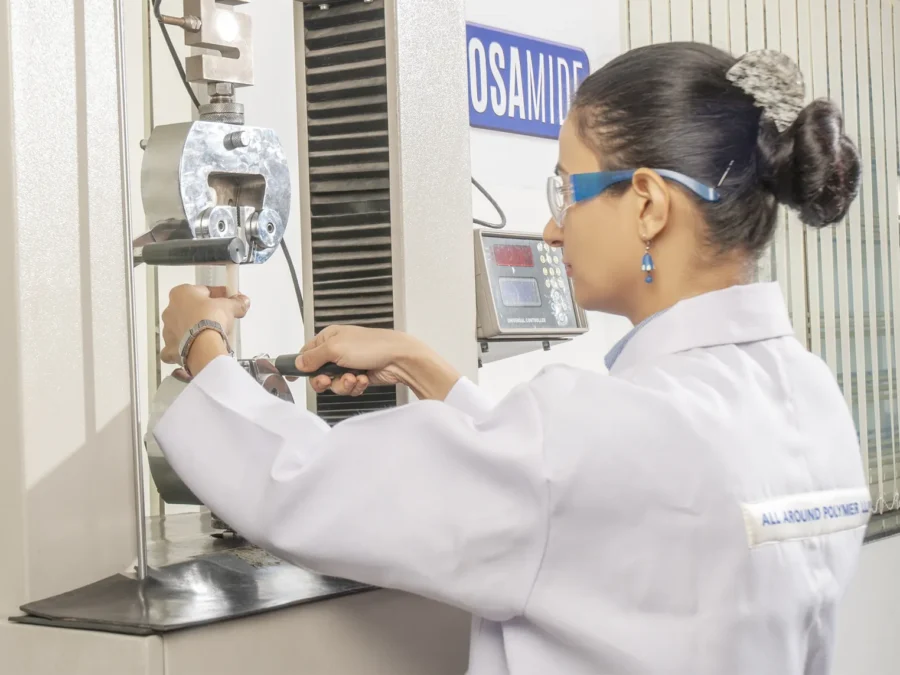
Our lab includes a glow-wire tester, so we screen trial formulations against GWFI and GWIT targets during development. UL 94 classification and other certified tests run through external laboratories on request. AAP is ISO 9001:2015 certified, and our compounds comply with RoHS and REACH. Browse the material finder or our applications page.
Writing an FR spec a compounder can meet
- The UL 94 rating, with the minimum thickness and the colour.
- Glow-wire: GWFI and GWIT targets, or the end-product temperature your part must pass.
- CTI or PLC, if creepage distances depend on it.
- Halogen-free: yes or no, in writing.
- Mechanical and thermal targets, with the test standards you will use to check them.
- Processing facts: thinnest wall, flow length, gate type and cycle time.
FAQ
Is UL 94 V-0 enough for a household appliance part?
Often not. Under IEC 60335-1, parts near live connections in unattended appliances also need glow-wire performance. A V-0 material can still fall short of a GWIT target, so ask for both values at the thickness you mould.
Does RoHS compliance mean halogen-free?
No. RoHS restricts named substances such as PBB and PBDE, so a compound using other brominated flame retardants can still be RoHS compliant. Halogen-free is a separate, stricter requirement; specify it explicitly.
Can AAP test glow-wire on a trial formulation?
Yes. Glow-wire testing is in our in-house lab, so we screen formulations quickly. Certified classifications, including UL 94, are arranged through external labs on request.
If you are specifying an FR grade for a connector, housing or appliance part, request a TDS or sample and tell us the rating, thickness and colour you need.
Sources
- UL Solutions: Combustion (fire) tests for plastics, UL 94
- TE Connectivity: Glow wire testing for the appliance industry (white paper)
- ROLEC: Fire safety test methods and standards, glow-wire parameters
- IB Lenhardt: Glow wire test IEC 60695-2-11, GWFI and GWIT
- Comparative Tracking Index, IEC 60112 and UL 746A PLC bands
- European Commission: RoHS Directive, restricted substances
- pinfa: Phosphorus, inorganic and nitrogen flame retardants