The Compound · Materials
PBT vs PA66 for Connectors and Housings: How to Choose
Open a wiring harness and most connector housings are one of two materials: glass-filled PBT or glass-filled PA66. Both mould well, both take flame retardants, and both are available everywhere. They differ in how they handle water, heat and toughness, and those differences decide which one survives your validation plan.
The datasheet comparison
| Property | PBT GF30 (hydrolysis resistant) | PA66 GF30 | Why it matters |
|---|---|---|---|
| Density | 1.51 g/cm³ | 1.36 g/cm³ | Part weight and cost per part |
| Moisture, 23 °C / 50% RH | 0.2% | 1.5-1.9% | Dimensional and electrical stability |
| Water absorption, saturation | 0.4% | 5.2-5.8% | Wet or immersed service |
| Melting point (DSC) | 223 °C | 260 °C | Absolute heat limit, solder and peak exposure |
| HDT A at 1.8 MPa | 205 °C | 250 °C | Short-term heat under load |
| Max. service temperature, short cycles | 210 °C | 240 °C | Peaks, not continuous exposure |
| Tensile modulus | 8,700 MPa | 10,000 dry / 7,200 cond. | Latch stiffness and pin retention |
| Stress at break | 130 MPa | 190 dry / 130 cond. | Strength in service |
| Charpy notched, 23 °C | 12 kJ/m² | 11 dry / 20 cond. | Toughness of latches and thin walls |
| Shrinkage, parallel / normal | 0.50 / 1.30% | 0.53 / 1.02% | Tool sizing and warpage |
| CTI (test liquid A) | 400 | 550 (cond.) | Creepage distances |
Typical values from two published BASF datasheets, Ultradur B4300 G6 HR (PBT-GF30) and Ultramid A3EG6 (PA66-GF30), for orientation only. “Cond.” means equilibrium at 23 °C and 50% RH; the PBT grade is published with single values because its moisture uptake is small. Values for OSABATE and OSAMIDE grades are on each grade TDS.
Moisture: PBT’s main advantage
Polyamide absorbs water from the air until it reaches equilibrium. In the PA66 reference grade, that takes tensile modulus from 10,000 to 7,200 MPa, a loss of 28%, and it changes the part’s size as it swells. The electrical values move too: volume resistivity falls from 1013 to 1010 ohm·m, and relative permittivity at 100 Hz rises from 4.2 to 9.7 between dry and conditioned.
PBT takes up between a tenth and an eighth as much water, so a PBT connector measured on the day it is moulded is essentially the connector that goes into service. Pin positions, latch engagement and seal compression stay where the drawing put them. For dense, small-pitch connectors and electronic housings with tight tolerances, this is usually the deciding factor.
Moisture is not all bad for PA66. Absorbed water plasticises the nylon, so conditioned notched Charpy almost doubles, from 11 to 20 kJ/m². A PA66 latch that cracks dry-as-moulded may flex happily once conditioned, which is why nylon connectors are sometimes moisture-conditioned before assembly. The effect of moisture on part size is covered in our guide to drying nylon and dimensional stability.
Heat: PA66’s main advantage
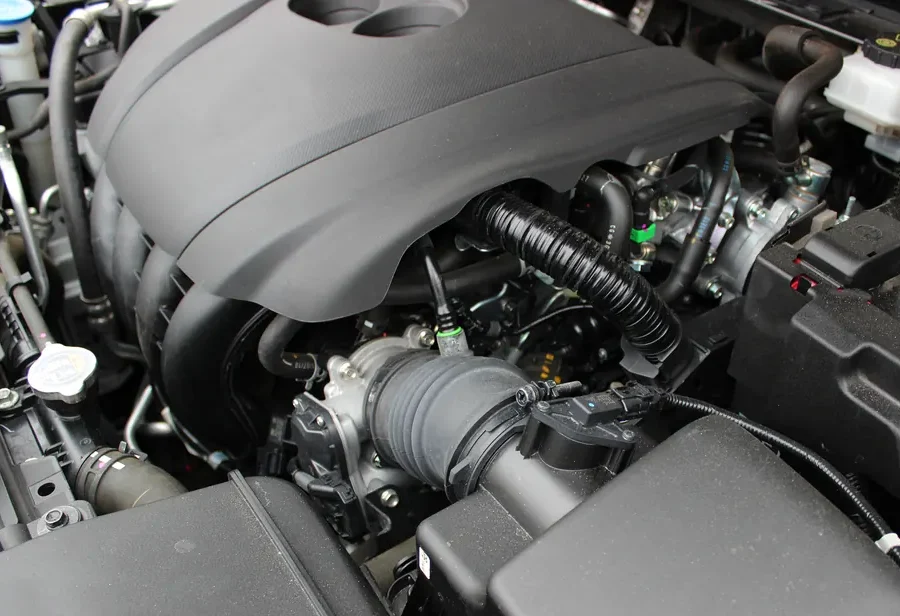
PA66 GF30 melts at 260 °C and carries an HDT of 250 °C. PBT GF30 melts at 223 °C with an HDT of 205 °C. For parts close to an engine, an exhaust or a hot busbar, that margin is real. Long-term service depends on the heat stabiliser package as much as on the polymer: the PA66 reference grade quotes a temperature index of 165 °C at 5,000 hours. Compare stabilised grade with stabilised grade, on ageing data at your temperature.
Hydrolysis: PBT’s weak point
PBT is a polyester, made by a condensation reaction that releases water. Given enough heat and humidity, the reaction runs backwards and the chains are cut. BASF’s published work on hydrolytically stable PBT showed a standard PBT GF30 with no hydrolytic degradation after storage at 50 °C and 75% RH or in water at 60 °C. At 85 °C and 85% RH, hydrolysis did occur.
That matters because connector qualification is built around exactly those conditions. Cycle tests in humid air from -40 to 150 °C are common for under-hood connectors, and USCAR-type test plans include high-humidity cycles. For under-hood and powertrain connectors, specify a hydrolysis-resistant PBT and ask for retained tensile properties after the humidity ageing in your specification. PBT also has to be dried well before moulding: the BASF processing data calls for less than 0.04% moisture.
Warpage and appearance
In these datasheets the PBT grade shrinks 0.50% along the flow and 1.30% across it, against 0.53% and 1.02% for PA66. That larger difference can warp flat housings and long, thin connector bodies. A glass-plus-mineral PBT reduces the anisotropy at some cost to strength, which is why our OSABATE 506 GF15 MR15 exists alongside the 30% glass OSABATE 506 GF. PBT also crystallises fast and gives a good surface, which helps short cycles.
Flame retardancy, glow-wire and tracking
Both polymers are routinely made flame retardant for connectors, terminal blocks and relay parts, with brominated or halogen-free packages. The rules that apply are the same for both:
- A UL 94 rating belongs to a thickness and a colour. Ask for the rating at your thinnest wall.
- Appliance parts follow IEC 60335-1. For parts supporting connections above 0.2 A in unattended appliances, the first route is a material GWFI of at least 850 °C, then a GWIT of at least 775 °C, or end-product glow-wire tests.
- CTI sets creepage distances. In the reference datasheets the PA66 grade lists 550 and the PBT grade 400, but flame-retardant packages move CTI, so compare the FR grades you will actually buy.
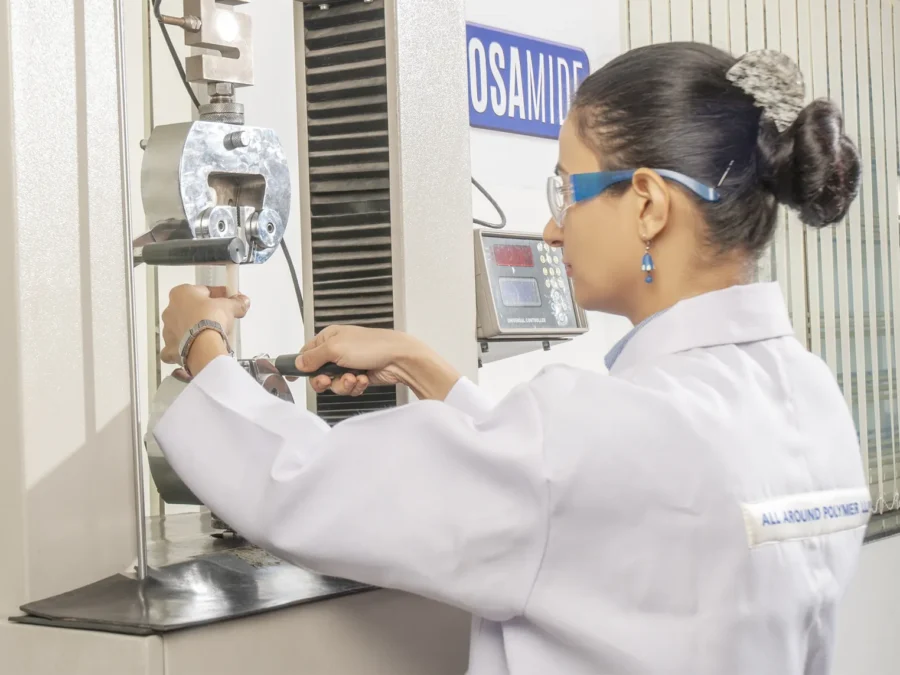
Our lab runs glow-wire tests during development, and certified UL 94 testing can be arranged at external laboratories. Options per family are on our flame-retardant compounds page; high-voltage connector requirements are covered on EV compounds.
How to choose
| If the part | Lean towards |
|---|---|
| Has tight pin pitch, sealing faces or tolerances in humid air | PBT |
| Needs stable insulation values whatever the humidity | PBT |
| Sees short peaks above about 200 °C, or sits close to a heat source | PA66 (or a PPA beyond it) |
| Has latches or snap fits that deflect hard | PA66 |
| Must pass 85 °C / 85% RH or humid thermal cycling | Hydrolysis-resistant PBT, or PA66 |
| Is a flat housing where warpage matters | Glass-plus-mineral PBT |
Mapping to AAP grades
In our OSABATE PBT range, 503 GF, 504 GF and 506 GF carry 15, 20 and 30% glass, 506 GF15 MR15 combines glass and mineral, and 5000 is an unfilled anti-static grade. Flame-retardant versions are made for connectors and electrical parts. On the polyamide side, OSAMIDE AISG 6 is PA66 with 30% glass and AISG 3 carries 15%.
FAQ
Is PBT or PA66 better for automotive connectors?
Neither wins everywhere. PBT is the usual choice for small connectors and electronic housings because it barely absorbs moisture. PA66 is preferred near heat and where latches need toughness. Under-hood PBT connectors should use a hydrolysis-resistant grade.
Why do my PA66 connectors change size after moulding?
They absorb moisture from the air until they reach equilibrium, which swells the part and softens it. Measure parts conditioned, or design with conditioned data from the start.
Does PBT need drying if it absorbs so little water?
Yes. Moisture in the melt hydrolyses PBT in the barrel. The BASF processing data for its PBT GF30 calls for less than 0.04% moisture, typically 4 hours at 80 to 120 °C in a dry-air dryer.
Which polymer is better for flame-retardant connectors?
Both reach UL 94 V-0 and high glow-wire values with the right package. The choice usually follows the moisture, heat and toughness arguments above, then the FR grade is matched to the thickness, colour and CTI you need.
Choosing between PBT and PA66 for a connector or housing? Send the drawing, the validation plan and the flammability targets through our contact page, and we will send TDS data for the matching OSABATE and OSAMIDE grades, or samples.
Sources
- BASF: Ultradur B4300 G6 HR product information (PBT-GF30, hydrolysis resistant)
- BASF: Ultradur B4300 G6 HR processing data sheet
- BASF: Ultramid A3EG6 product information (PA66-GF30)
- BASF, Kunststoffe international 5/2008: Testing gets tougher, hydrolytically stable PBT
- UL Solutions: Combustion (fire) tests for plastics, UL 94
- TE Connectivity: Glow wire testing for the appliance industry (white paper)