The Compound · Design
UV-Stabilised Compounds for Outdoor Plastic Parts
An outdoor plastic part can pass every test on the day it is moulded and fail in its second summer. Sprinkler bodies, drip fittings, sprayer parts, tractor panels, mirror housings and grilles all live under strong sun, often with water, heat, fertilisers and dust on top. Whether they last depends on choosing the right polymer, the right stabiliser package and a test that reflects real exposure.
What sunlight does to plastics
Ultraviolet light carries enough energy to break chemical bonds. With oxygen present, the broken bonds start a chain reaction of free radicals that cuts polymer chains and forms carbonyl groups. Heat and moisture speed it up. Damage starts at the surface and works inward, so the first signs are cosmetic: lower gloss, chalking, yellowing or fading. Then microcracks form, and because cracks act as notches, impact strength and elongation fall long before tensile strength does.
Polymers differ widely in how much help they need:
| Polymer | Unstabilised outdoor behaviour | Usual approach |
|---|---|---|
| PP | Poor; embrittles and chalks | HALS plus UV absorber; carbon black for black parts |
| POM | Poor; surface chalking and cracking | UV-stabilised grades, dark colours preferred |
| ABS | Poor; yellows and loses impact | UV-stabilised grades or painted parts |
| PC and PC/ABS | Yellows | UV absorbers; coatings for clear parts |
| PA6, PA66 | Moderate; natural colour yellows | Carbon black or UV-stabilised packages |
| PBT | Moderate | UV-stabilised grades for visible parts |
How UV stabilisers work
- UV absorbers, such as benzotriazoles and triazines, absorb UV and release it as heat. They need path length to work, so they protect the bulk of a part better than its outermost layer, and they are essential in light and transparent colours.
- HALS, hindered amine light stabilisers, do not absorb UV. They trap the free radicals that start degradation and are regenerated in the process, which is why they protect for a long time at low loadings. In polyolefins such as PP they do most of the work.
- Pigments screen the light. Carbon black absorbs across the UV range and is the most effective single protection for black parts; how well it works depends on particle size, structure, loading and, just as much, dispersion. Poorly dispersed black protects far less than the same amount well dispersed.
- Antioxidants protect the polymer during compounding and moulding and against heat in service. A part that runs hot in the sun needs both.
Two interactions catch people out. Some HALS are deactivated by acidic chemicals, including sulphur- and halogen-containing agrochemicals, so tell the compounder what a sprayer or greenhouse part will be exposed to. And flame retardants, fillers and pigments can all change how much stabiliser a grade needs, so the package has to be designed for the whole formulation, not added from a standard recipe.
Testing: what to put in the specification
| Method | Standards | Typical use |
|---|---|---|
| Xenon arc | ISO 4892-2, ASTM G155 | Closest lab match to the full sunlight spectrum; colour and property retention |
| Xenon arc, automotive exterior | SAE J2527 | Exterior trims and mouldings; the OEM specification sets duration and evaluation |
| Fluorescent UV with condensation | ISO 4892-3, ASTM G154 | Fast screening and ranking of formulations |
| Natural outdoor exposure | Site exposure, for example ISO 877 | Validation and long-term correlation |
The most common mistake is to treat chamber hours as years. Q-Lab, which builds both kinds of tester, states that a single conversion number is theoretically impossible: outdoor severity varies with location, season and year, by as much as 2:1 between successive years at the same site. Accelerated results are best used to rank materials against each other and against a reference with known field history.
A usable specification names four things:
- The method and cycle, including filters, irradiance, temperature and water spray or condensation.
- The exposure, preferably as radiant exposure in kJ/m² or MJ/m² in a stated wavelength band, not just hours.
- The pass criteria: colour change as delta E, gloss retention, retained tensile elongation and impact, and no cracking or chalking.
- The baseline: unexposed specimens from the same lot, tested at the same time.
Agriculture and irrigation
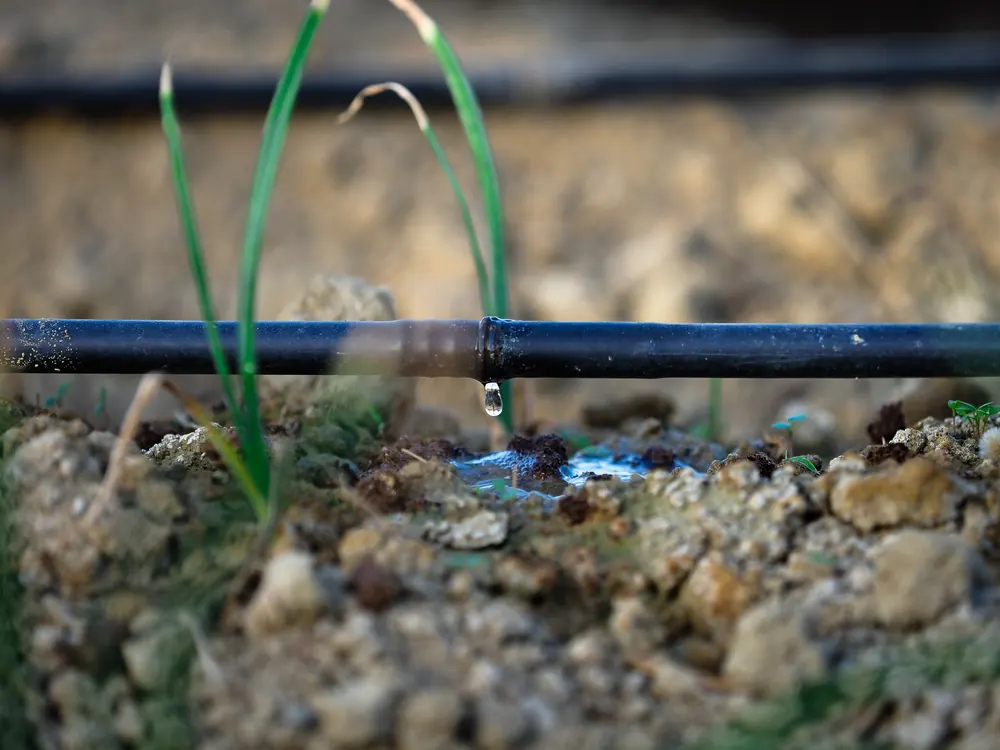
Farm parts face the harshest combination: sun all day, water, fertilisers and agrochemicals, abrasion from soil, and impact from handling. Typical moulded parts are sprinkler and nozzle bodies, drip and lateral fittings, valve and filter housings, sprayer components, and tractor panels, grilles and covers. Black parts are the most robust because carbon black does so much of the work. Colour-coded parts in blue, red or green rely on organic stabiliser packages and should be tested for fade as well as embrittlement.
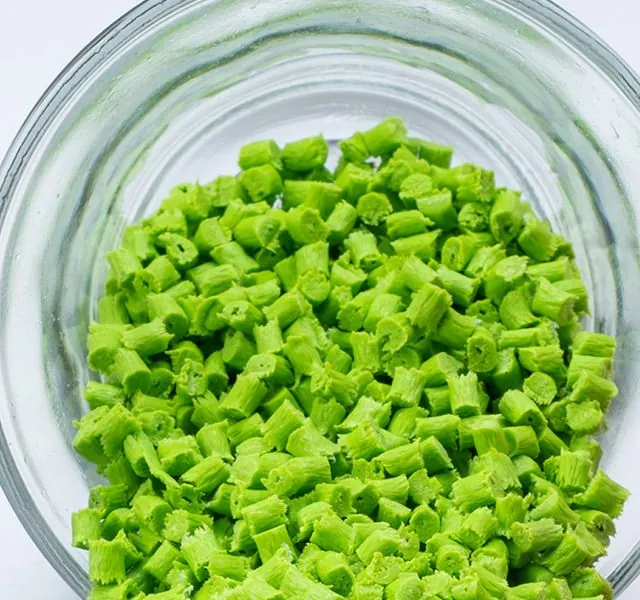
For these parts we start from UV-stabilised PP such as OSALENE PPTF 15 (15% talc, high UV stabilised, high impact) and, where stiffness is needed, OSALENE 20 BST (20% glass, high UV stabilised). For clips, valve parts and other sliding or snap-fit parts outdoors, OSATAL 4000 HI UV is a lubricated, UV-treated POM. More on the sector is on our agriculture page.
Exterior automotive trims
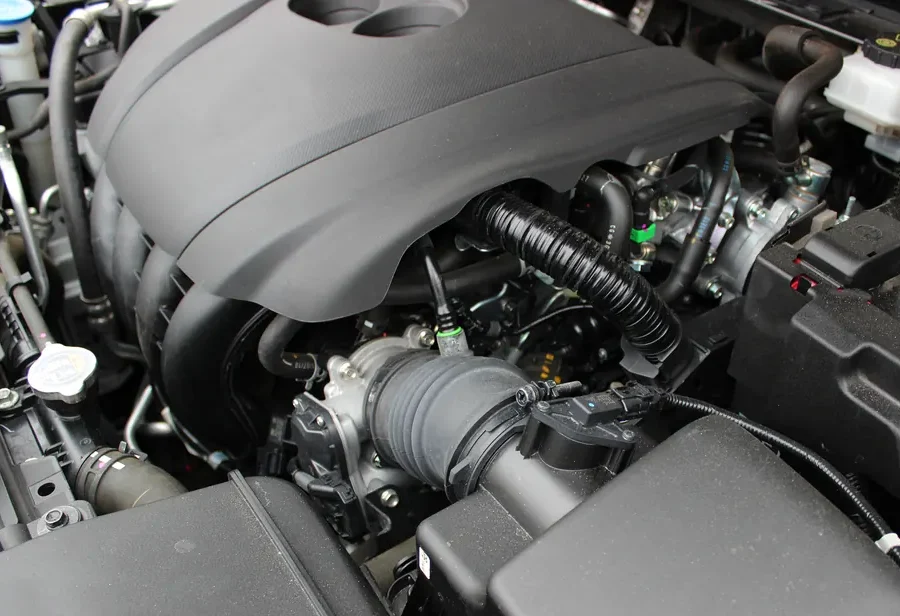
Mirror shells, grilles, cowl and pillar trims, lamp parts and two-wheeler body parts are often moulded in colour, with no paint to protect them. The OEM specification usually calls for xenon exposure to SAE J2527 or its own equivalent, with limits on delta E, gloss change and surface defects, and often a retained-impact requirement. Painted parts rely on the paint, but the substrate still needs enough stabilisation for edges and stone chips.
Our starting points include OSAALLOY CP 6080, an impact-modified, UV-stabilised PC/ABS with good flow, OSAALLOY 7030 HBK (PA/ABS, UV treated) and OSALAC 3107 (SAN with 35% glass, UV and heat stabilised). PC grades with UV stabilisation are developed to order in OSANATE.
Choosing a grade: the brief
- Colour: black, dark, light or natural, and whether colour hold matters or only mechanical life.
- Exposure: region, orientation, hours of direct sun, and design life in years.
- Function after exposure: impact, snap-fit strength, appearance, or all three.
- Wall thickness: thin walls lose a larger share of their section to surface damage.
- Chemicals: fertilisers, agrochemicals, cleaners, fuels.
- Heat: dark parts in direct sun run well above air temperature, so specify heat stabilisation as well.
- Test plan: method, cycle, exposure, pass criteria and baseline.
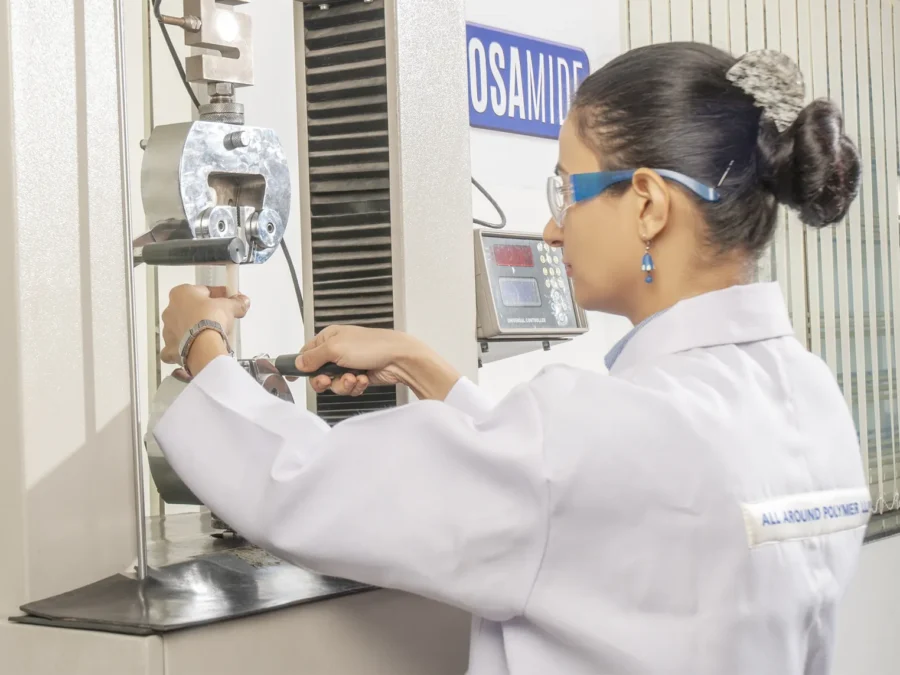
UV-stabilised grades sit in our PP, POM, ABS and SAN, alloy and PC families, and colour-matched versions are made to order. Our lab measures colour and delta E on a spectrophotometer, and tensile and impact on the UTM and pendulum testers, so retained properties on exposed panels can be read against an unexposed baseline from the same lot; see our quality page.
FAQ
How many hours of xenon or QUV equal one year outdoors?
There is no universal figure. Outdoor severity varies by site, season and year, and each material responds differently. Labs build their own correlations for one material, one cycle and one site; use chamber results to rank candidates.
Is black always the best colour for outdoor parts?
For UV resistance, well-dispersed carbon black is the most effective protection. But black parts run hotter in sun, so heat ageing becomes part of the specification.
Does UV stabilisation change other properties?
At normal loadings the effect on mechanical properties is small. The bigger risks are interactions with flame retardants, fillers and acidic chemicals, which is why the package is designed for the full formulation.
Can a UV-stabilised grade be colour matched?
Yes. Colour is matched and checked on a spectrophotometer with a delta E limit. For strong colours, test colour hold under exposure as well as the initial match.
Specifying an outdoor part? Send the part, colour, exposure conditions and test specification through our contact page, and we will propose a UV-stabilised grade and a trial formulation.
Sources
- Q-Lab: How many hours in a Q-SUN or a QUV equals a year of outdoor exposure?
- Intertek: Xenon arc accelerated exposure
- Intertek: Accelerated weathering by QUV
- Q-Lab: SAE J2527, xenon arc exposure of exterior automotive materials
- Cabot: Specialty carbons for ultraviolet protection and weatherability
- Brostow et al., Effects of UV stabilizers on polypropylene outdoors, Materials 13 (2020)