The Compound · Design
Glass-Filled PP vs Glass-Filled Nylon for Brackets
Brackets, carriers and housings are where glass-filled PP and glass-filled nylon meet. Both are cheap enough for high-volume parts, both mould well, and on a datasheet the nylon looks better on almost every line. Yet glass-filled PP carries a great many automotive and appliance brackets. The reason is in the conditions the part actually sees, and in the arithmetic of density and price.
The datasheet comparison
| Property | PP GF30, coupled | PA6 GF30 | PA66 GF30 |
|---|---|---|---|
| Density | 1.13 g/cm³ | 1.36 g/cm³ | 1.36 g/cm³ |
| Tensile modulus, dry / cond. | 6,500 MPa | 9,600 / 5,700 MPa | 10,000 / 7,200 MPa |
| Stress at break, dry / cond. | 84 MPa | 170 / 100 MPa | 190 / 130 MPa |
| Charpy notched, 23 °C, dry / cond. | 10 kJ/m² | 10 / 18 kJ/m² | 11 / 20 kJ/m² |
| HDT A at 1.8 MPa | 160 °C | 205 °C | 250 °C |
| Moisture, 23 °C / 50% RH | Negligible | 1.9-2.3% | 1.5-1.9% |
| Melting point | About 165 °C | 220 °C | 260 °C |
Typical values from published datasheets: LyondellBasell Hostacom FPP 30GFC NAT (chemically coupled PP homopolymer, 30% glass), BASF Ultramid B3WG6 (PA6-GF30) and A3EG6 (PA66-GF30). The PP melting point is the textbook value for homopolymer. PP takes up so little water that its datasheet gives one value. Shown for orientation only.
Stiffness: read the conditioned column
Dry, the nylons are about 50% stiffer than the PP. But a polyamide part does not stay dry. At equilibrium in 23 °C, 50% RH air, PA66 GF30 drops to 7,200 MPa, only about 10% above the PP, and PA6 GF30 drops to 5,700 MPa, below it. Glass-filled PP takes up practically no water, so its stiffness on day one is its stiffness in the monsoon.
Density sharpens the comparison. For a flat wall loaded in bending, stiffness rises with modulus times thickness cubed, so the wall needed for equal stiffness scales with the cube root of the modulus ratio. Using the figures above, an equally stiff PA66 GF30 wall weighs about 16% more than the PP wall when the nylon is conditioned, and about 4% more when it is dry. Against conditioned PA6 GF30, the PP part is about 20% lighter. Ribbed parts change the exact numbers, not the direction.
Temperature reverses the picture. Both polymers lose stiffness as they warm, but PP starts closer to its softening range. The PA6 GF30 grade above still holds 4,500 MPa at 80 °C, dry. For any part that runs warm, ask both suppliers for modulus against temperature, not the 23 °C value alone.
Creep: the bracket killer
A bracket rarely fails on day one. It carries a module, a hose or a harness for years, and under that constant load every plastic slowly creeps. PP sits well above its glass transition at room temperature, so it creeps more than nylon at the same stress, and the gap grows with temperature. Glass fibre helps both, but it does not remove the difference.
Design with creep modulus, not short-term modulus. The PA66 reference grade gives a tensile creep modulus of 5,300 MPa after 1,000 hours at 23 °C, conditioned, against a short-term 7,200 MPa. Ask for ISO 899-1 creep curves for each candidate at your service temperature and stress. Bolted joints deserve the same attention: a glass-filled PP boss under a bolt will relax over time, so use a metal compression limiter wherever clamp load matters, in either material.
Heat
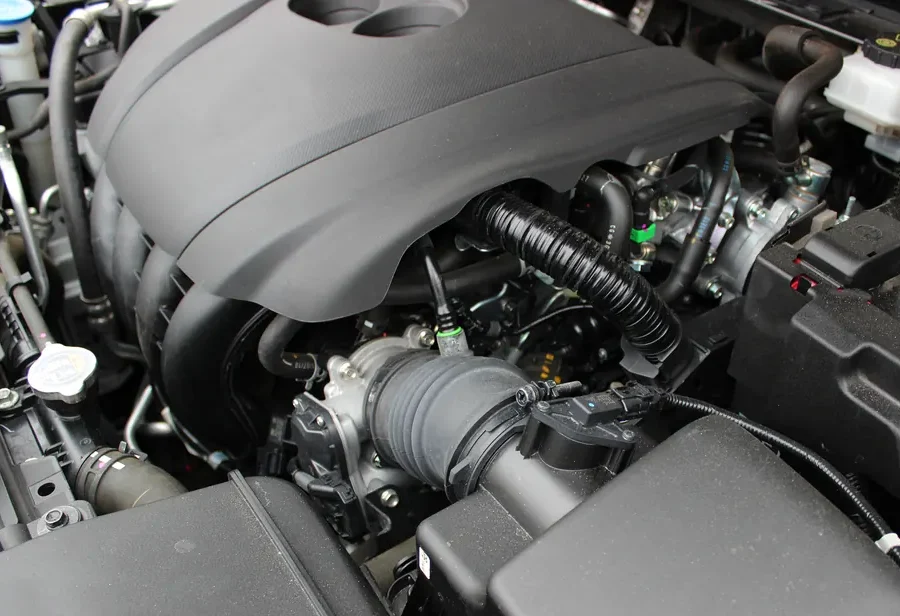
HDT gives the first cut. A coupled PP GF30 deflects at about 160 °C under 1.8 MPa, PA6 GF30 at 205 °C and PA66 GF30 at 250 °C. HDT is a short-term test, close to the melting point for glass-filled semi-crystalline polymers, so it overstates continuous capability. For long service at temperature, compare heat-stabilised grades on ageing data: retained tensile strength and impact after the hours and temperature in your specification. Engine-bay brackets near hot surfaces are nylon territory; cabin, boot and appliance brackets are usually well inside PP’s range.
Moisture, chemicals and the environment
- Water and humidity. PP is unaffected, which helps in wet appliances and humid climates. Nylon swells and softens as it absorbs water; see PA66 GF30 vs PA6 GF30 for how far.
- Oils, fuels and greases. Nylon resists them well. PP can swell in hydrocarbons, especially when hot, so check under-hood fluids.
- Acids, alkalis and detergents. PP is strong here, one reason it dominates washing-machine and dishwasher parts.
- Painting and bonding. PP’s low surface energy needs flame, plasma or primer treatment. Nylon bonds and paints more readily.
Cost logic: per part, not per kilogram
Compounds are bought by the kilogram, but parts are filled by volume. Multiply price per kilogram by density to get price per litre. At equal volume, a PA66 GF30 part uses about 20% more material by weight than a PP GF30 part. For a conditioned, equally stiff wall the nylon part is about 16% heavier, so the nylon would need to cost no more than about 86% of the PP compound’s price per kilogram just to break even. That is rare.
Nylon pays back in other ways: a part that would need a heat shield, a metal insert or a second component in PP, a load that would creep PP out of tolerance, or a temperature PP cannot reach. If the comparison is against steel or aluminium, our metal-to-plastic tool runs the same logic on weight and stiffness.
A selection path
- Write down the maximum temperature, how long it lasts, and the load at that moment.
- Compare stiffness at service temperature and humidity, using conditioned data for nylon.
- For constant loads, compare creep at temperature. This removes PP from many under-hood parts.
- Check the fluids, cleaning agents and sunlight the part will see.
- Compare cost per part, using density and the wall each material needs.
- Mould both in the production tool if you can. Shrinkage and warpage differ.
Mapping to AAP grades
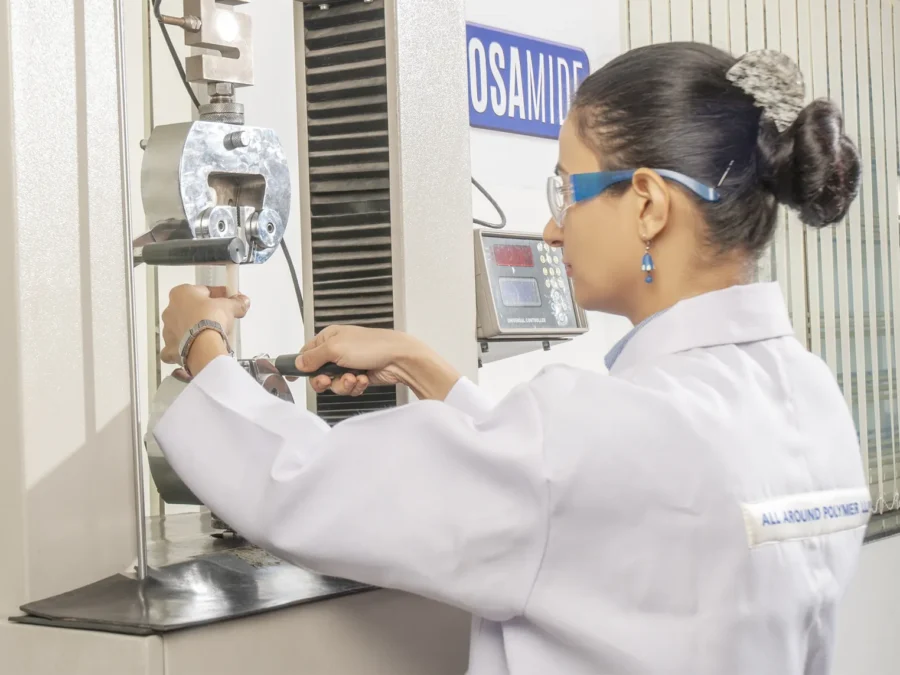
Our OSALENE glass-filled PP grades include 20 BST (20% glass, high UV stabilised), OSALENE 30 NST (30% glass, heat stabilised) and PP GM 35 BK (25% glass plus 15% mineral, heat stabilised) for parts that need lower warpage. On the nylon side, OSAMIDE BISG 6 is PA6 with 30% glass and OSAMIDE AISG 6 the PA66 equivalent, with BRG 4 (PA6, 20% glass) below them. Our lab runs tensile, flexural, Izod, Charpy and HDT tests, so a side-by-side comparison of your shortlist is practical before tooling.
FAQ
Can glass-filled PP replace glass-filled nylon in a bracket?
Often, if the bracket runs well inside the PP grade’s heat limits, carries a moderate constant load and does not see hot oils. Check creep at service temperature and cost per part before you decide. Close to an engine or exhaust, nylon is the safer starting point.
What does “chemically coupled” mean for glass-filled PP?
PP does not bond to glass on its own. A coupling agent, usually maleic-anhydride-grafted PP, links the glass sizing to the polymer so that load passes into the fibres. Uncoupled glass PP is much weaker, so make sure the grade you compare is coupled.
Does glass-filled PP need drying before moulding?
Usually not, because PP does not absorb water. Dry it only if pellets have picked up surface moisture, for example after cold storage. Nylon must always be dried.
Why does a glass-filled PP bracket loosen at the bolt?
The plastic under the bolt head creeps and the clamp load relaxes. Use a metal compression limiter, increase the bearing area, or move to a material with lower creep at that temperature.
Choosing between glass-filled PP and nylon for a bracket or housing? Send the drawing, loads, temperatures and annual volume through our contact page, and we will recommend OSALENE or OSAMIDE grades and send samples for a tool trial.