The Compound · Materials
PA66 GF30 vs PA6 GF30: How to Choose the Right Glass-Filled Nylon
On a drawing, PA6-GF30 and PA66-GF30 differ by a single character. In a finished part they can differ by 45 °C of heat resistance, a fifth of the in-service stiffness and a noticeable step in price and supply risk. The glass fibre does most of the mechanical work in both. The polymer around it decides how the part behaves when it is hot, wet, or both.
Same glass, different backbone
PA6 is made by ring-opening polymerisation of caprolactam. PA66 is built from two monomers, hexamethylenediamine and adipic acid. The PA66 chain is more regular, so it packs into crystals more tightly, melts higher and sets up faster in the mould. It also takes up slightly less water.
With 30% glass fibre in both, dry stiffness is almost identical. The differences appear at temperature, and after the part has come to equilibrium with humid air.
What the datasheets say
| Property | PA66 GF30 | PA6 GF30 | Why it matters |
|---|---|---|---|
| Melting point (DSC) | 260 °C | 220 °C | Processing window and absolute heat limit |
| HDT A at 1.8 MPa | 250 °C | 205 °C | Short-term heat resistance under load |
| Max. service temperature, short cycles | 240 °C | 200 °C | Peaks, not continuous exposure |
| Temperature index, 5,000 h | 165 °C | 175 °C (heat-stabilised) | Long-term ageing; stabiliser-dependent |
| Tensile modulus, dry / conditioned | 10,000 / 7,200 MPa | 9,600 / 5,700 MPa | Stiffness the part has in service |
| Stress at break, dry / conditioned | 190 / 130 MPa | 170 / 100 MPa | Strength after moisture uptake |
| Moisture at 23 °C / 50% RH | 1.5–1.9% | 1.9–2.3% | Dimensional change and property loss |
| Moulding shrinkage, parallel / normal | 0.53 / 1.02% | 0.30 / 0.85% | Tool sizing |
| Recommended melt temperature | 280–300 °C | 270–290 °C | Energy use and degradation margin |
Typical values from two published BASF Ultramid datasheets (A3EG6 and B3WG6), shown for orientation only. "Conditioned" means equilibrium at 23 °C and 50% RH. Values for OSAMIDE grades are on the grade TDS.
Read the conditioned row first. Dry, the two grades are within 5% on tensile modulus. Conditioned, the PA66 grade keeps 72% of its dry modulus and the PA6 grade keeps 59%. If the part is a bracket in a humid engine bay, or a housing that will spend its life in monsoon air in Ho Chi Minh City or Jakarta, the conditioned column is the honest one.
Where PA66 GF30 earns its premium
- Load-bearing parts near heat. An HDT of 250 °C against 205 °C is real margin for clips, brackets and covers close to hot surfaces.
- Stiffness in humid service. Higher conditioned modulus and strength mean thinner walls or fewer ribs for the same deflection.
- Short thermal peaks. The quoted short-cycle service limit is 240 °C for the PA66 grade against 200 °C for PA6.
- Thin walls and fast cycles. PA66 crystallises quickly, which helps cycle time once the tool is properly heated.
The heat-ageing trap
HDT is a short-term test. Continuous service life is governed by thermal-oxidative ageing, and that depends heavily on the heat-stabiliser package. In the same producer's data, a heat-stabilised PA6 GF30 carries a 5,000-hour temperature index of 175 °C, higher than the 165 °C of a general-purpose PA66 GF30. "PA66 for heat" only holds when both grades carry comparable stabilisation. Ask for ageing data at your temperature, not just HDT.
Where PA6 GF30 is the better answer
- Visible surfaces. PA6's lower melt temperature and slower crystallisation give the melt more time against the tool steel, which usually means less fibre show-through.
- A wider processing window. Recommended melt temperatures run about 10 °C lower, leaving more margin before degradation.
- Ductility after conditioning. Strain at break rises to 7% for the conditioned PA6 grade, against 5% for PA66.
- Supply security and cost. PA66 depends on adiponitrile and HMD intermediates. In January 2019 Wood Mackenzie counted the eleventh force majeure in the PA66 industry within twelve months. PA6 runs on caprolactam, a separate chain, which is why many buyers approve both polymers on the drawing.
A selection sequence that survives validation
- Write down the worst-case temperature, how long it lasts and the load on the part at that moment.
- Design to conditioned properties at service temperature. The PA6 GF30 grade above falls to 4,500 MPa tensile modulus at 80 °C, dry, less than half its 23 °C value.
- Check the chemical environment: coolant, fuel, grease, road salt, cleaning agents.
- Decide whether appearance matters.
- Decide whether the drawing names one polymer or allows an approved alternative.
- If you can, mould both in the production tool. Shrinkage is not the same.
Mapping to OSAMIDE grades
In our OSAMIDE range, AISG 6 is PA66 with 30% glass fibre and BISG 6 is the PA6 equivalent. Either side of them sit AISG 3 (PA66, 15% GF), BRG 4 (PA6, 20% GF), BRG 8 (PA6, 40% GF) and 80 G 40 H, a heat-stabilised, impact-modified PA6 with 40% glass. Flame-retardant, UV-stabilised and custom-coloured versions are available on request; see our notes on flame-retardant compounds.
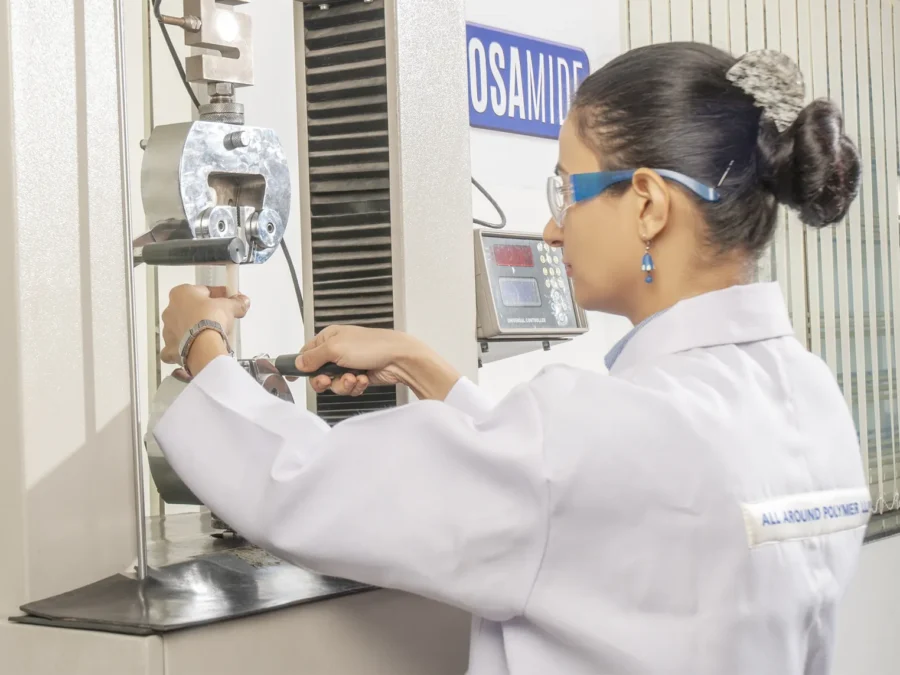
If neither polymer holds up at your temperature, the next step is a semi-aromatic polyamide, covered in PA6T and PPA compounds. Our lab moulds its own test specimens and runs tensile, flexural, Izod and HDT/VSAT tests, so a side-by-side comparison of your shortlist is practical before tooling is committed. The material finder covers the rest of the portfolio.
FAQ
Can I switch from PA66 GF30 to PA6 GF30 without changing the tool?
Sometimes, but plan a trial. In the reference datasheets above, shrinkage parallel to flow is 0.53% for the PA66 grade and 0.30% for the PA6 grade. On a 200 mm dimension that is a difference of about 0.46 mm, enough to matter on a sealing face or a snap fit.
Does PA6 GF30 absorb much more water than PA66 GF30?
Somewhat more: 1.9–2.3% against 1.5–1.9% at 23 °C and 50% RH, and 6.3–6.9% against 5.2–5.8% at saturation. The effect on stiffness is larger than those numbers suggest. Our guide to drying nylon and dimensional stability covers what happens to part size.
Do both grades need drying before moulding?
Yes. Both reference datasheets recommend pre-drying at 80 °C for four hours, and DuPont's moulding guide sets the limit for nylon at below 0.2% moisture before moulding. Check the TDS for each OSAMIDE grade.
Shortlisting a 30% glass-filled nylon for a new part? Send your operating temperature, environment and annual volume through our contact page and we will send the TDS for OSAMIDE AISG 6 and BISG 6, or samples for your own trials.