The Compound · Processing
Inside the Polymer Compounding Process on a Twin-Screw Line
A buyer sees two things from a compounder: a bag of pellets and a technical data sheet. Everything that decides whether the next bag behaves like the last one happens in between, on the line. This is a walk through the polymer compounding process on a twin-screw line, with notes on what each stage controls and what a careful buyer can ask about.
The machine: a co-rotating twin-screw extruder
Most engineering-plastics compounding runs on co-rotating, intermeshing twin-screw extruders. Two screws turn in the same direction inside a segmented barrel. Each screw is assembled from short elements on a splined shaft: conveying elements to move material, kneading blocks to melt and mix it. Rearranging those elements is how one line can run talc-filled PP in the morning and 50% glass PA66 in the afternoon.
At AAP we run four twin-screw compounding lines at Jhajjar, Haryana, rated at 1,250, 400, 250 and 75 kg/hr. Combined nameplate capacity is 1,975 kg/hr, or about 9,500 tonnes a year on a 16-hour operating pattern. The 75 kg/hr line is kept for R&D and small development batches. Between them, the lines run PA6, PA66, PC blends, PBT, ABS and glass- or mineral-filled PP, plus flame-retardant, coloured, conductive and recycled-content grades.
Stage by stage
| Stage | What happens | What goes wrong if it is off |
|---|---|---|
| Raw material and recipe | Incoming checks; recipe, BOM and process window issued | Wrong lot, wet resin, outdated recipe |
| Main feed | Polymer and additives metered into the throat | Ratio drift, uneven stabiliser or pigment |
| Melting and mixing | Kneading blocks melt and disperse | Unmelts and specks, or degraded polymer |
| Glass side-feed | Chopped glass enters the melt downstream | Broken fibres, low or uneven glass content |
| Venting | Air, moisture and volatiles removed | Porous strands, splay on moulded parts |
| Die, bath, pelletiser | Strands cooled and cut | Irregular pellets, fines, wet pellets |
| Drying and QC | Pellets conditioned, sampled, tested | Moisture complaints, off-spec batches shipped |
1. Raw material in, recipe out
Every batch starts with an incoming raw material test report: the first of our three testing stages. Hygroscopic base polymers such as PA, PBT and PC have to reach the throat dry, because water carried into the melt breaks polymer chains and shows up later as lost toughness. Recipe versions, bill of materials and process window are controlled in our ERP, so the line runs the approved formulation rather than the one someone remembers.
2. Main feed
Base polymer, stabilisers, lubricants, pigments and flame retardants are metered into the main feed throat at fixed ratios. Small additives do a lot of work at low loadings, so a feeding drift of a fraction of a percent can move colour or heat-ageing performance noticeably.
3. Melting and mixing
Kneading blocks do two jobs. Dispersive mixing breaks down agglomerates of pigment, FR or filler; distributive mixing spreads them evenly. Too little shear leaves unmelted pellets and specks. Too much overheats the melt and degrades the polymer. The screw layout and screw speed are where a compounder balances the two.
4. Side-feeding glass fibre
Chopped glass enters through a twin-screw side feeder mounted on a downstream barrel section, after the polymer is fully molten. Fed with the solid pellets, the fibres would be ground down in the melting zone, and fibre length in the moulded part is what carries stiffness and strength. After the side feeder, mixing is deliberately gentle: enough to wet out and distribute the glass, no more. This is also why high-glass grades, such as OSAMIDE compounds with up to 65 to 70% glass fibre, are as much about screw design as formulation. For what that glass buys you in a part, see PA66 GF30 vs PA6 GF30 and metal replacement with glass-filled polyamide.
5. Venting
Glass and fillers drag air in with them, so a vent after the side feeder lets it escape. Closer to the die, a vacuum vent pulls out moisture, residual monomer and other volatiles. Poor venting shows as bubbles in the strand and as splay or porosity in moulded parts, often blamed on the moulder's dryer when the cause sits upstream.
6. Die, water bath and strand pelletiser
The melt leaves through a die plate as a row of strands, runs through a water bath to solidify, is dewatered with air, and is cut to length by a strand pelletiser. Strand pelletising suits a compounder that changes materials and colours often, because the train is quick to clean. Consistent pellet length matters more than it seems: uneven pellets feed unevenly at the moulding machine.
7. Drying and packing
The water bath leaves surface moisture on every pellet, and polyamides and PBT start absorbing water at once. On a well-run line, moisture-sensitive grades are dried before packing. Even so, the moulder should dry again before moulding; our note on drying nylon explains why.
QC: what is tested, and why it matters to you
In-process and prototype tests form our second testing stage, and random tests on finished product before dispatch form the third. Batch genealogy runs from the recipe version to the shipment.
| Check | Equipment in our lab | What it tells the moulder |
|---|---|---|
| Melt flow (MFI) | MFI tester | Batch-to-batch flow consistency; a rise can signal degradation |
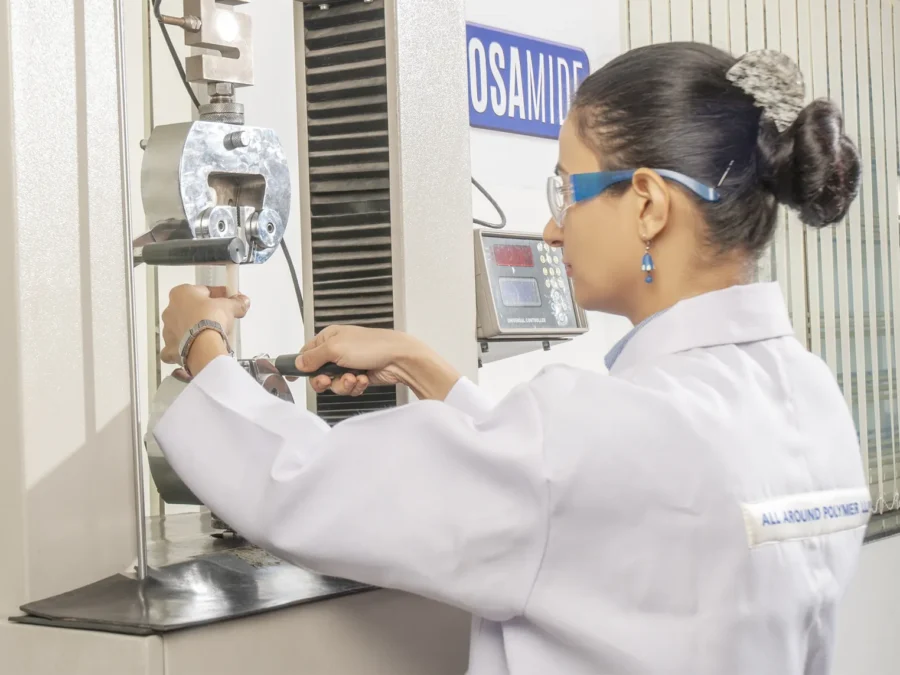
| Tensile and flexural | UTM | Strength and stiffness against the TDS |
| Impact | Izod tester | Toughness; sensitive to moisture and degradation |
| HDT and Vicat | HDT/VSAT tester | Heat performance under load |
| Melting and crystallisation | DSC | Polymer identity, nucleation, blend behaviour |
| Polymer identity and contamination | FT-IR | Confirms base polymer and flags foreign material |
| Colour | Spectrophotometer | Colour difference against the approved standard |
| Flammability screening | Glow-wire tester | Ignition behaviour of FR grades |
| Test specimens | Injection moulding machine | Moulded bars for all of the above |
Filler content is commonly verified by ashing under ISO 3451-1. External lab testing is available on request for tests outside our in-house list. You can see how these capabilities fit together on our capabilities page.
FAQ
Why is glass fibre side-fed instead of added in the hopper?
In the hopper, the fibres would pass through the melting zone alongside solid pellets and be broken up. Side-feeding into molten polymer, followed by gentle mixing, keeps more fibre length in the pellet and therefore in your moulded part.
What is the difference between nameplate and practical capacity?
Nameplate is the rated throughput of the lines: 1,975 kg/hr combined at AAP. The practical figure of about 9,500 tonnes a year reflects a 16-hour operating pattern. Throughput on any day also depends on the product mix, since high-glass and FR grades run differently from unfilled ones.
Can you run a small batch for a development trial?
Yes. Our 75 kg/hr line is dedicated to R&D and small-batch development, so trial quantities do not wait for a slot on a production line.
To see how a specific grade is made and tested, request a TDS or sample or browse the material finder.