The Compound · Sourcing
Vetting an Engineering Plastics Supplier in India: 2027 Checklist
More procurement teams in Vietnam, Thailand, Indonesia, Türkiye, Germany, Mexico, Japan and Korea now have an Indian compounder on their shortlist. Part of the reason is the domestic market those compounders have grown up serving. India approved a ₹25,938 crore production-linked incentive scheme for automobiles and auto components in September 2021, running from FY2022-23 to FY2026-27. Trade policy matters too. India has a goods agreement with ASEAN (2010) and comprehensive partnership agreements with Japan (2011) and Korea, and India and the EU concluded free-trade negotiations in January 2026, with signature and ratification still to follow.
None of that qualifies a supplier. This is the checklist we would use ourselves, followed by our own answers.
The checklist
| Area | What to ask for | Red flag |
|---|---|---|
| Quality system | ISO 9001 certificate number, issuing body, scope and expiry; IATF 16949 status stated precisely | "IATF compliant" with no certificate or dated plan |
| Technical data | TDS listing ISO test methods, with dry and conditioned values | Single "typical" values with no method |
| Lot release | CoA for every lot against agreed parameters and limits | A CoA that simply repeats the TDS |
| Regulatory | Signed, dated RoHS and REACH declarations per grade; IMDS support | One generic letter covering "all products" |
| Colour | Master plaque, spectrophotometer readings, agreed illuminant and ΔE tolerance | Visual approval only |
| Automotive approval | What the supplier contributes to your PPAP: process flow, PFMEA, control plan, lab reports | Unfamiliarity with the terms |
| Samples | Lead time split into formulation, lab batch and dispatch; real lot numbers | Samples from equipment that will never run production, undisclosed |
| Commercial terms | Incoterms 2020 rule and named place; packaging specification; HS code on the pro forma | "FOB" quoted for air or courier shipments |
| Traceability | A live trace of a past lot from raw materials to shipment | Traceability "available on request" |
| Capacity | Nameplate and practical capacity; which lines can run your grade | One line, no fallback |
Three items that cause most of the trouble later
Certification status, stated precisely
IATF 16949 certificates are issued only through IATF-recognised certification bodies, and the IATF plans to publish a second edition of the standard in mid-2027. A supplier can be certified, in transition, or at gap-assessment stage. Any of these may be workable for a given programme, depending on your customer-specific requirements, but you need to know which one you are dealing with. India's MSME Sustainable (ZED) certification, awarded at Bronze, Silver and Gold levels, is a useful signal of process discipline in a smaller manufacturer. It does not replace an automotive quality system.
Declarations that stay current
RoHS currently restricts ten substances. Under REACH Article 33, a supplier of an article containing a Candidate List substance above 0.1% by weight must pass on safe-use information. The Candidate List grows over time, so ask how and when declarations are refreshed. For automotive parts, IMDS is the industry's material data system; agree early who creates the entry for the compound and what composition data it needs.
Incoterms and HS code on the pro forma
Incoterms 2020 has eleven rules. Name the rule, the place and the edition: "FCA [named place] Incoterms® 2020" leaves little room for argument. EXW puts export clearance on the buyer, which is awkward from abroad, and FOB, CFR and CIF are meant for sea and inland waterway transport only. Polyamides in primary forms sit under HS heading 39.08, with 3908.10 covering PA6 and PA66 and 3908.90 the other polyamides. Confirm with your broker how your customs authority treats a filled compound.
How All Around Polymer answers the checklist
- Quality system. ISO 9001:2015 certified and ZED certified. We state RoHS and REACH compliance; ask for the declaration covering your grade. IATF 16949: not certified. A gap assessment is scheduled. We would rather say that here than have it surface in your supplier audit.
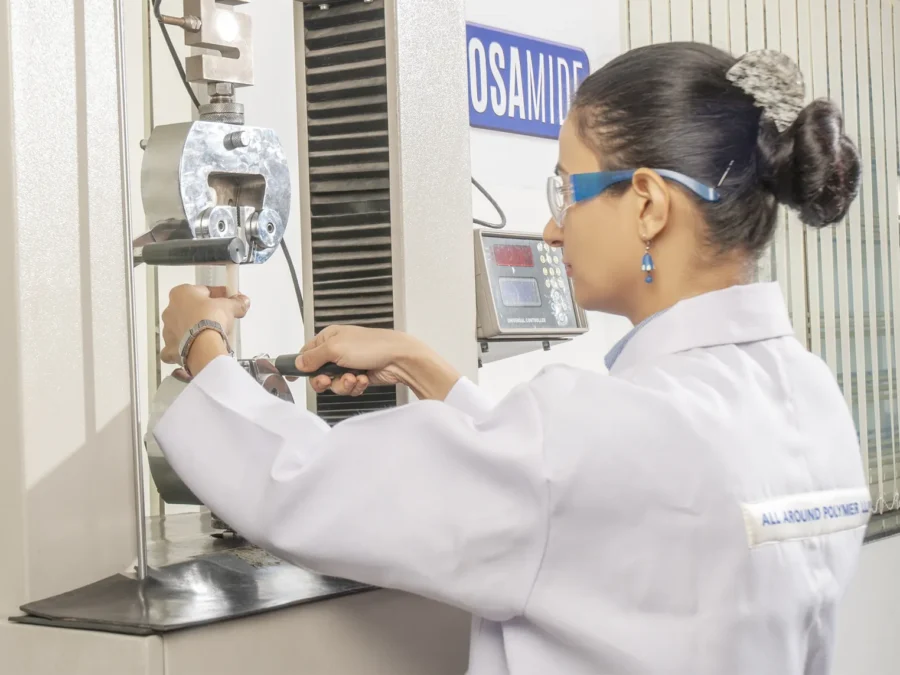
- Testing. Three stages: incoming raw-material test reports, in-process and prototype tests, and random tests on finished product before dispatch. In-house equipment covers DSC, FT-IR, MFI, UTM (tensile and flexural), Izod impact, HDT/VSAT, spectrophotometric colour measurement and glow-wire, with injection moulding for specimen preparation. External laboratory testing on request.
- Traceability. ERP-controlled recipe versions, bills of materials and process windows, with batch genealogy through to the shipment.
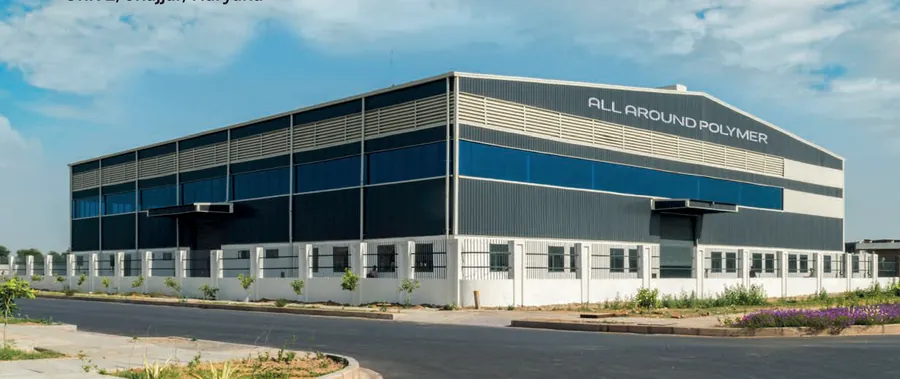
- Capacity. Four twin-screw compounding lines with a combined nameplate of 1,975 kg/hr, about 9,500 tonnes a year in practice on a 16-hour pattern, across two owned plants in MET City, Jhajjar, Haryana. Unit 2 has spare capacity.
- Development. A trial formulation within 48–72 hours of a complete request. More than 150 new grades in four years, with 70–80% of development projects converting to supply.
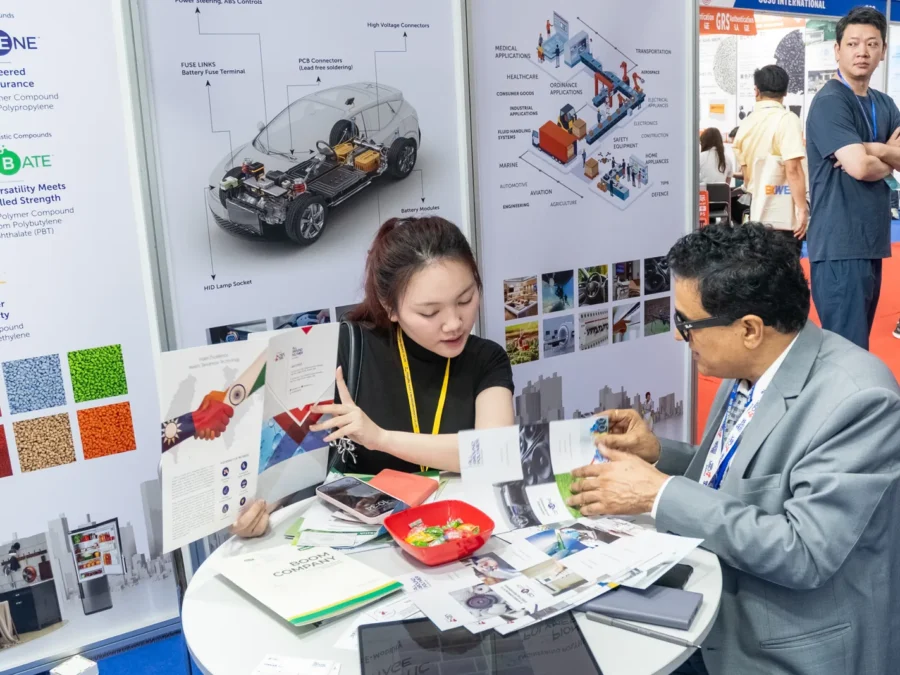
- Export experience. Customers in Taiwan, Thailand, South Africa, Vietnam and Mexico; we exhibited at HanoiPlas 2025 in Hanoi.
- PPAP and IMDS. If your programme needs them, raise it at enquiry so the documentation is scoped into the development plan from the start.
The grades are in our material finder, from OSAMIDE polyamides to OSABATE PBT and OSAALLOY blends. The plant and process are described on our capabilities page and in inside a compounding line; development steps are in custom compound development.
FAQ
Is ISO 9001 enough for an automotive compound supplier?
That depends on your customer-specific requirements, so ask your supplier quality engineer early. If IATF 16949 certification is mandatory for the programme, ask the supplier for its current status and a dated plan. If it is not, agree in writing what audit or documentation will stand in for it.
Which Incoterms rule suits compounds shipped from India?
If you run your own forwarder, FCA at the supplier's premises or a named point is usually cleaner than EXW, because the seller handles export clearance. If the supplier arranges main carriage, CIP works for any mode and CIF for sea only; for door delivery, look at DAP. Whatever you choose, write the place and "Incoterms® 2020" into the contract.
How fast can I get a sample from All Around Polymer?
For a custom formulation, our development team aims to have a trial formulation ready within 48–72 hours of a complete request. Add dispatch and courier time, and the slot on your own moulding machine.
Building a supplier shortlist? Use our contact page to request a TDS, a sample or a supplier questionnaire response, and tell us your target market and annual volume.
Sources
- Ministry of Heavy Industries: PLI scheme for automobile and auto component industry
- India Briefing: India's international free trade and tax agreements
- The Week (PTI): India, EU conclude negotiations for FTA, January 2026
- IATF Global Oversight: Stakeholder Communiqué 2026-005 on IATF 16949 revision status
- IATF Stakeholder Communiqué 2026-005, timeline (PDF copy)
- PIB: MSME Sustainable (ZED) Certification
- European Commission: RoHS Directive
- Swiss Notification Authority for Chemicals: articles with substances of very high concern (REACH Art. 33)
- IMDS: International Material Data System
- ICC: Incoterms rules
- World Customs Organization: HS Nomenclature 2022, Chapter 39