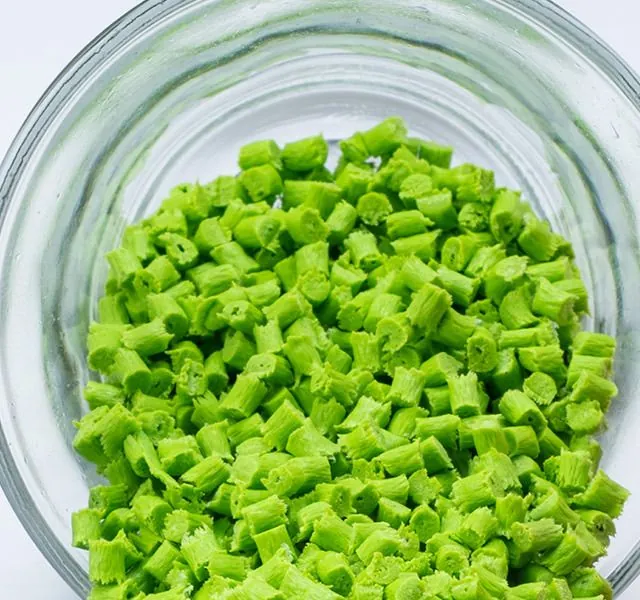
Post-industrial recycled
PIR compounds for automotive parts
Post-industrial recycled PP, TPO, PA6, PA66 and ABS compounds, made to your material specification. The first step to recycled content on a vehicle, with the data your approval needs.
What counts as PIR
ISO 14021 defines post-industrial, or pre-consumer, recycled material as material diverted from a manufacturing waste stream before it reaches a consumer. Rework or regrind reclaimed within the same process that generated it does not count.
Because the source stream is known, PIR is cleaner, more consistent and single-source. That makes it the natural first step for recycled content in automotive parts, from post-industrial recycled polypropylene on the underbody to recycled nylon under the hood.
We never sell PIR as-is. Each grade is a formulation: PIR base polymer plus the additive package your part needs, engineered to a target property set.
- Definition: ISO 14021, pre-consumer material
- Feedstock kept segregated by source
- Polymer identity confirmed by FT-IR before dosing
- Same laboratory, ERP and QC as our virgin grades
PIR grades and typical parts
Recycled PP compounds for automotive parts are the largest group, with nylon and ABS grades for under-hood and interior substructure.
| Grade | Typical parts | Related family |
|---|---|---|
| rPP, talc- or glass-filled | Wheel-arch liners, splash guards, underbody shields, air ducts, engine covers, bumper brackets | OSALENE |
| TPO blends | Bumper substrates, exterior cladding | OSALENE |
| rABS and rPC-ABS | Interior trim carriers, non-visible brackets, console substructure | OSALAC, OSAALLOY |
| rPA6 and rPA66 | Under-hood brackets, structural clips, fan and shroud parts | OSAMIDE |
Start with non-visible parts and scale as data builds. Each grade is set against your material specification; the parts listed are typical, not a limit.
Why automotive programmes start with PIR
Recycled content has to pass the same approval as any other material change. PIR keeps the variables few.
-
Consistent feedstock
A known, single-source stream is cleaner and more consistent than post-consumer material.
-
Clear origin
The source is known, so the recycled claim can be documented against ISO 14021 definitions.
-
Non-visible parts first
Underbody, under-hood and interior substructure parts are judged on properties, not on colour or surface.
-
A route to PCR
Once a part runs on PIR and data builds, rPP grades can move to PCR where the part allows it.
Odour and consistency, controlled at the source
Interior and under-hood parts are judged on smell as well as strength. We control odour where it starts: feedstock selection, devolatilisation during twin-screw compounding, and odour-absorber additives where the part needs them. VDA 270 limits are agreed per part, and VDA 278 emissions join the property set where your specification calls for them.
Consistency comes from recipe-locked dosing and batch testing. Every batch is checked for MFI, density, ash, tensile, flexural, Izod, HDT and delta E before dispatch and ships with a CoA. Batch genealogy in our ERP traces each lot from feedstock to shipment.
- VDA 270 odour limits agreed per part
- Devolatilisation during compounding
- Recipe-locked dosing in ERP
- MFI, density, ash, mechanical tests, HDT and delta E on every batch
How to qualify a PIR grade
The same path as any material change on an approved part, run with your engineering team.
- 01
Share the part and the target
Send the drawing or current material specification, the recycled share you are aiming for and the rule or customer requirement behind it.
- 02
Trial formulation
We propose a formulation in 48-72 hours and test it in our laboratory against your property window.
- 03
Samples for moulding trials
Sample lots from our 75 kg/hr line for R&D and small batches, with test data for each lot.
- 04
PPAP and on-vehicle trials
Material-spec conformance data and lot documentation for your PPAP, followed by on-vehicle trials.
- 05
Series supply
Lot-traced supply on the approved recipe, with a CoA on every lot.
Related pages
- Recycled compounds: PIR and PCRHow we engineer and control recycled grades, and the rules driving demand.
- PCR compoundsPost-consumer recycled grades for crates, dunnage and non-visible parts.
- OSALENEPP compounds: impact-modified, talc, glass and glass plus mineral.
- OSAMIDEPA6 and PA66 compounds, the base for our rPA6 and rPA66 grades.
- OSALACABS and SAN compounds for housings, grilles and lamp parts.
- OSAALLOYPC/ABS, PA/ABS and other blends for housings and interior parts.
PIR compounds: buyer questions
Is PIR the same as regrind?
No. Under ISO 14021, rework or regrind reclaimed within the same process that generated it does not count as recycled content. PIR is material diverted from a manufacturing waste stream and compounded into a new grade.
Which parts should we convert first?
Non-visible parts with a clear property window, such as wheel-arch liners, splash guards, underbody shields, air ducts and brackets. Scale to more demanding parts as data builds.
Can a PIR grade meet our VDA 270 limit?
We agree the VDA 270 limit per part at the start and design the grade to it, through feedstock selection, devolatilisation and odour absorbers where the part needs them.
Do you supply recycled nylon PA66 compounds?
Yes. rPA6 and rPA66 grades from PIR feedstock, on an OSAMIDE base, for under-hood brackets, structural clips, fan and shroud parts.
What documentation comes with each lot?
A certificate of analysis with every lot, and batch genealogy in our ERP from feedstock to shipment. For approval, we provide material-spec conformance data for your PPAP.
How fast can we get a trial formulation?
In 48-72 hours from a clear brief. Tell us the sample quantity your moulding trial needs and we will confirm timing.
Qualify a PIR grade on your next part
Send the part drawing, the material specification and your recycled target, and we will propose a trial formulation in 48-72 hours.